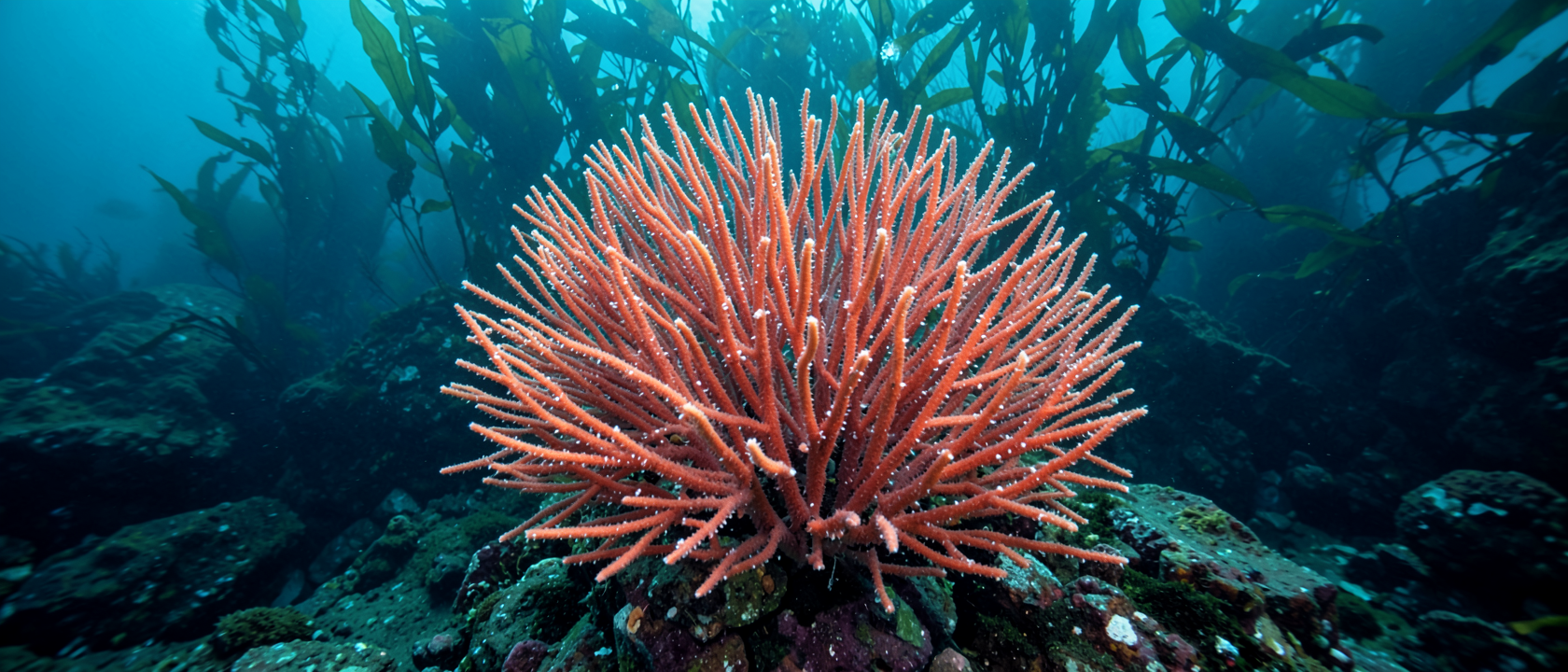
The Coral That Flexes
Touch a branch of Leptogorgia chilensis, the red gorgonian that lives on rocky seafloor beneath the kelp forests of the Pacific coast from California to Chile, and it stops swaying. One moment it is bending in the current like any other soft coral, an octocoral with no stony, reef-building skeleton to speak of. The next moment that same branch is rigid, and nothing inside it is bone or shell. The tissue itself made the call. That switch is the finding published by a team led by Ling Li at the University of Pennsylvania in the Proceedings of the National Academy of Sciences on October 27, 2025: a living animal doing on command what engineers usually have to force out of sand.
Grains of Sand, Underfoot
The trick starts with water. When the coral is stimulated, its tissue actively pumps water out, and the gel-like matrix wrapped around its mineral skeleton shrinks. Suspended in that gel are millions of sclerites, calcite particles roughly a tenth of a millimeter (0.004 inches) across, each shaped like a small rod with branching, spike-tipped arms growing off it. As the gel shrinks, it squeezes those sclerites closer together until the arms of neighboring sclerites hook into each other and hold. “Once the sclerites get close enough to their neighbors, their branches jam together, holding them in place,” says Chenhao Hu, the study’s first author and a doctoral student in Li’s lab. Physicists call this granular jamming, the same physics that turns loose, dry sand into a surface solid enough to stand on the instant your foot presses down at the waterline. Hu and collaborators at Virginia Tech, Brookhaven National Laboratory, Argonne National Laboratory, UC Santa Barbara, Harvard, MIT, and the Zuse Institute Berlin confirmed the mechanism using imaging, computational modeling, and mechanical testing, checking it from several directions rather than taking one lab’s word for it.
Why That Shape, and No Other
Sand jams once and stays jammed; you have to disturb the whole pile to free it again. This coral’s sclerites do something a sand grain cannot: they lock and release, in the same tissue, over and over. The researchers trace that reversibility to geometry. Each sclerite carries two axial branches and two sets of three-way, or triradiate, side branches, arranged in step with the crystal structure of the calcite itself, not a random shard but a specific shape. Plain spheres would slide past one another and never catch. Irregular grains, like sand, catch too well and stay locked once forced together. The branched-rod shape threads a narrower path: interlock hard enough to hold under force, then separate cleanly the moment the surrounding gel swells back out. That reads less like passive mineral debris and more like a mechanical part built for exactly one job, switching states on demand.
The Myth “Soft Coral” Just Broke
Gorgonians get filed under “soft coral” because they lack the rigid, reef-building skeleton of stony corals, and the label quietly assumes flexible means flexible, full stop. Leptogorgia chilensis breaks that assumption. Its softness turns out to be a state, not a fixed property, one it can switch off in the time it takes to expel a little water from its own tissue. Granular jamming itself was nothing new to physics; it has been studied for years in sand, and in party tricks like vacuum-sealed coffee grounds turning a floppy bag into a rigid brick the moment the air is pulled out. What had never been documented, per Li’s team, is that exact mechanism running inside a living organism, built from its own mineral particles rather than assembled by an engineer. The mistake was never in noticing that the coral bends. It was assuming bending was the only thing it could do.
What’s Still Unknown
Only one species has been tested this way. Other soft corals carry sclerites shaped nothing like Leptogorgia chilensis’s branched rods, and nobody yet knows whether those shapes jam the same way, jam differently, or fail to jam at all. Li’s team has floated the idea that a switchable, particle-based stiffening system like this could inform new designs in medicine, robotics, or manufacturing. That is a proposed direction, stated by the researchers as a possibility, not a device that exists yet. For now, the only confirmed machine running on this exact principle is the coral itself.