The Fact That Shouldn’t Be True
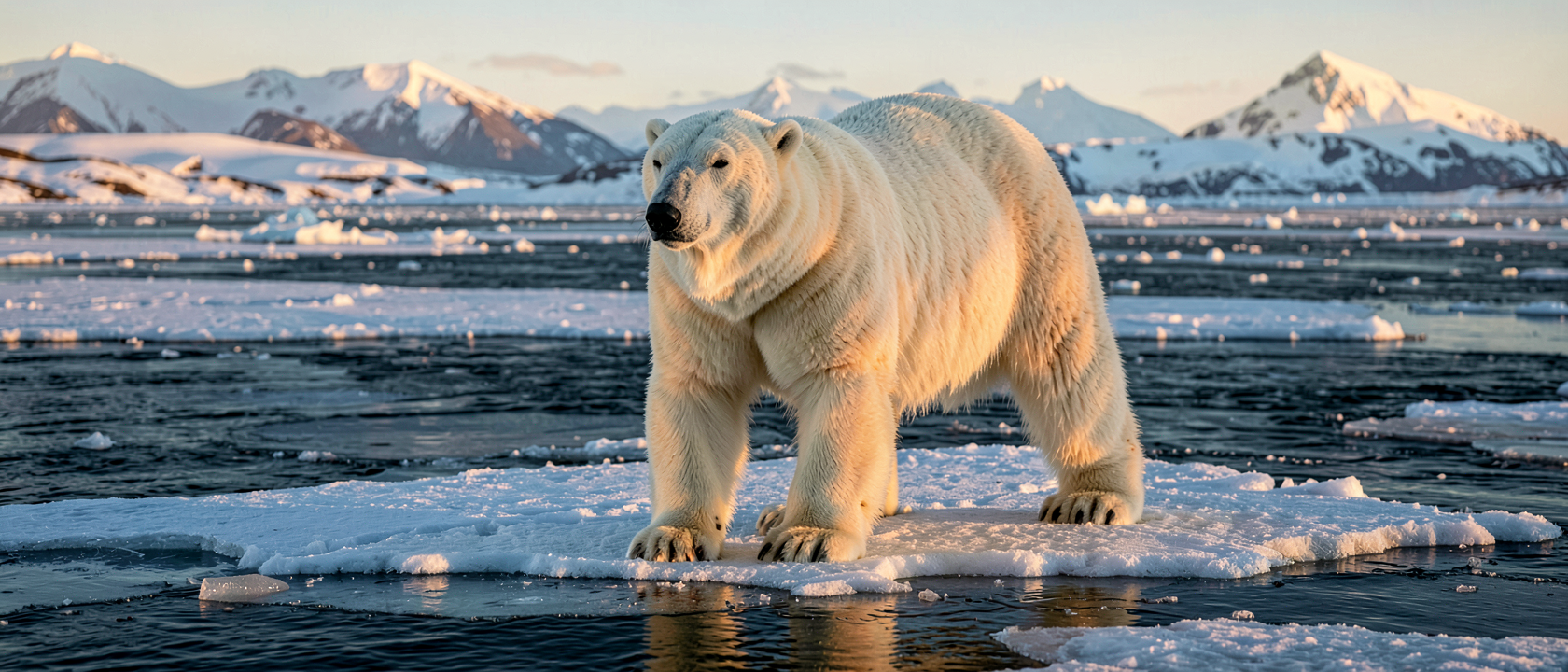
Between 1995 and 2019, polar bears on Svalbard got fatter, not thinner, while the sea ice under their paws disappeared at roughly twice the rate of most of the Arctic. Jon Aars and his colleagues at the Norwegian Polar Institute captured and measured 770 adult bears, 1,188 captures in total, during spring fieldwork across those 24 years, publishing the results in Scientific Reports. They tracked a body condition index, a score built from body length and chest girth that stands in for how much fat and muscle a bear is carrying relative to its frame. That index dropped through the late 1990s, then reversed and climbed after 2000, the same period in which the region’s ice-free season grew by about 100 days, roughly four extra ice-free days every year. The Barents Sea population, estimated at somewhere between 1,900 and 3,600 bears in 2004, held stable the whole time. Even Aars told AFP the reversal was a surprise.
What Losing Ice Is Supposed to Do to a Bear
Sea ice is not scenery to a polar bear. It is the hunting platform. Ringed seals (Pusa hispida) breathe through holes cut in the ice, and bears wait beside them, motionless, for the ambush. Pull the platform out from under a bear and the standard Arctic story plays out: longer swims between ice patches, more weeks stranded on land, and a fallback diet of seabird eggs or vegetation that cannot come close to matching seal blubber for calories. A study from the Beaufort Sea found that bears pushed onto land this way shift toward that lower-energy diet, and survival rates drop along with it. Reproduction is on the line too. Research by Derocher and Stirling on western Hudson Bay bears found that females weighing less than 417 pounds (189 kg) in autumn failed to produce cubs the following spring. That is the pattern everyone expected Svalbard to follow, given that the Barents Sea has been warming by up to 3.6°F (2°C) per decade over the past four decades, faster than almost anywhere else the species lives.
The Second Why: Reindeer and a Crowded Ice Shelf
Aars and his co-authors think the bears found a way around the missing platform. Svalbard reindeer (Rangifer tarandus platyrhynchus), hunted down hard in earlier centuries, have rebounded in number, and researchers have logged more and more sightings of bears killing them. A reindeer does not care whether the fjord is frozen. Bears across Svalbard have also increasingly been recorded eating eggs and birds from common eider ducks and geese, and stranded whale carcasses, fairly common along the archipelago’s coastline, can feed a bear for over a year. None of that requires a single day of sea ice. At the same time, the researchers propose the ice that remains may be doing the bears a favor: shrinking ice could be squeezing ringed seals onto fewer, smaller patches, which may make them easier, not harder, to find. Land prey filling the summer gap and marine prey clustering in whatever ice is left, that combination is the researchers’ working explanation for why the body condition curve bent upward instead of down.
What Nobody’s Tested Yet
Nobody has actually confirmed a bigger reindeer or walrus share on the menu. The paper reports more sightings and a mechanism that would fit the numbers, but it contains no diet data proving Svalbard’s bears eat measurably more land prey than they used to. That gap is why Alice Godden, a researcher at the University of East Anglia who was not involved in the study, points to a different candidate: genetic changes affecting fat metabolism and heat tolerance, already documented in a separate polar bear population in South Greenland. Whether Svalbard’s bears carry anything similar, an inherited edge rather than a change in menu, has not been tested. Reindeer, crowded seals, or something written into the bears’ own biology: all three sit in the same untested column.
The Myth This Kills
The assumption that vanishing sea ice always means a thinner, starving polar bear does not survive Svalbard’s numbers. Two and a half decades of accelerating ice loss ran alongside stable to improving body condition in this population, a pattern that does not hold for western Hudson Bay, the southern Beaufort Sea, or other Canadian Arctic populations, where survival has tracked ice loss downward exactly as the textbook predicts. But the researchers describe this as a temporary reprieve, not proof that ice loss is harmless: Aars himself says it remains likely Svalbard’s bears will get thinner over the long run if the sea ice keeps disappearing, since bears still need a minimum amount of ice each year, even if nobody knows yet exactly where that threshold sits. Polar bears cannot get through a full year with zero sea ice at any point in the calendar, no matter how many reindeer are standing around. Telling the difference between resilient for now and safe forever is the whole point of reading the study instead of the headline.