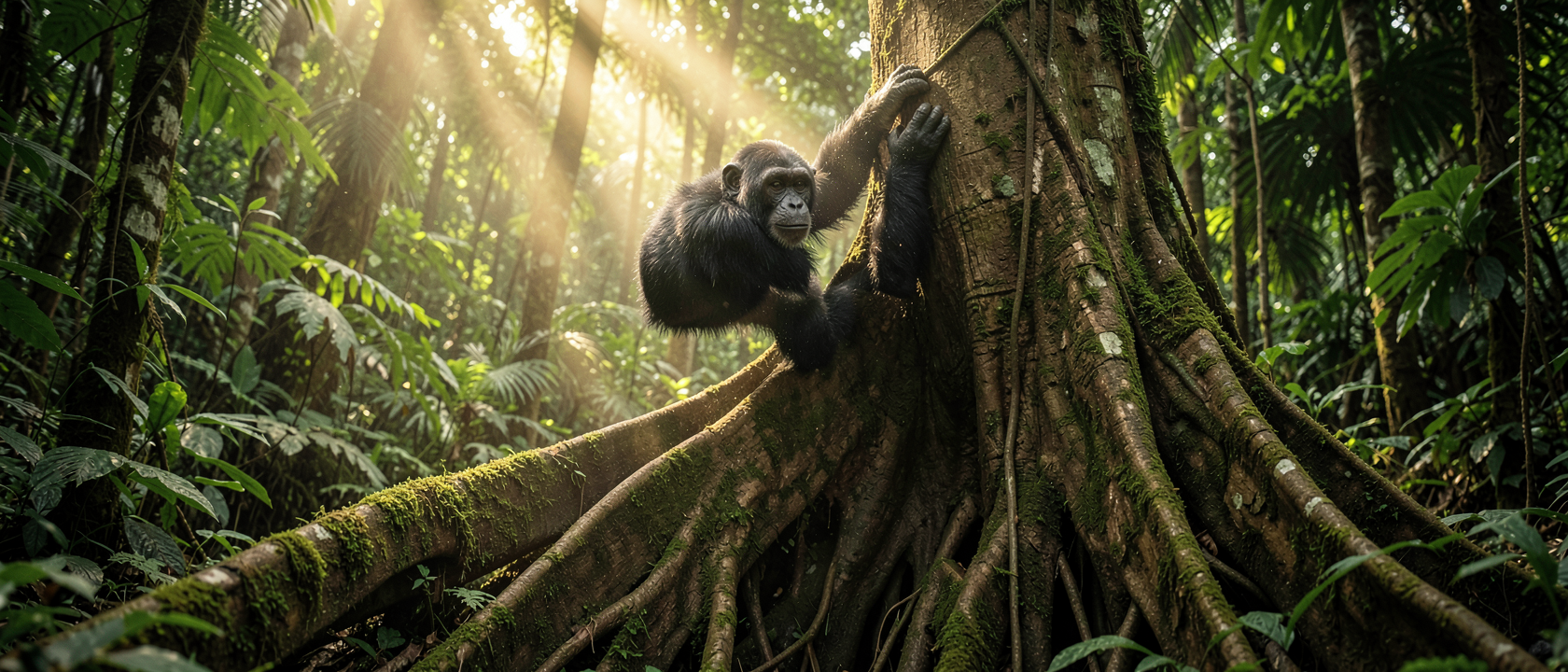
Wild chimpanzees drum. In the rainforests of Côte d’Ivoire, Guinea, Senegal, Uganda, and Tanzania, they strike the giant root buttresses of trees with their hands and feet, and the hits are not scattered. They land in a spaced-out beat, and each animal’s version of that beat is distinct enough that a researcher can often guess who is playing before the roots come into view.
371 Drum Solos, One Species
Vesta Eleuteri, a cognitive biologist at the University of Vienna, and Catherine Hobaiter, a primatologist at the University of St Andrews, logged 371 drumming bouts across 11 wild chimpanzee (Pan troglodytes) communities, spanning six populations and both recognized subspecies. Their analysis appeared in Current Biology. Eleuteri personally watched more than 350 of those performances unfold: a chimpanzee gripping the trunk with its hands while its feet slam into a buttress root, the wide, wall-like root some rainforest trees grow above the soil for extra support. The timing inside each bout wasn’t loose. It held to a rhythm.
A Root Big Enough to Be a Speaker
Here’s the mechanism. A buttress root works something like a drumhead, and the sound it generates travels through the forest well past shouting range, more than half a mile (800 meters) by the study’s account. Drumming rarely happens on its own; chimpanzees fold it into a long-distance call known as a pant-hoot. Split the two jobs and it reads like an intercom system. The vocal call carries identity and activity, who is calling and what they’re doing. The drum carries position, loud enough that group members far off can work out roughly where in the forest that call came from.
Two Rhythms, Maybe Two Societies
Drumming style also differed by region in a way that held across sites. Western chimpanzee communities struck more often and faster, hit after evenly spaced hit. Eastern communities drummed slower, started later inside a pant-hoot sequence, and alternated short and long silences between strikes. Eleuteri says the team expected exactly this: more hits and a quicker pace out of western populations. Hobaiter goes further and proposes the rhythm difference tracks a difference in how the two groups of societies are organized, more even and cohesive in the west, more hierarchical in the east. That’s her reading of the pattern, not a number the drumbeats themselves produce. The study measured timing, not social structure.
When Hoo Plus Pant Doesn’t Mean Hoo or Pant
A separate project, led by Cédric Girard-Buttoz, an evolutionary biologist at the CNRS, recorded 4,323 vocal utterances from 53 wild chimpanzees in Côte d’Ivoire and published the analysis in Science Advances. The team catalogued 12 distinct call types and found chimpanzees stringing them into hundreds of different sequences, combining as many as ten call types across the full repertoire. One pairing makes the point cleanly. A “hoo” on its own tends to show up around feeding or travel. A “pant” on its own tends to show up around social interaction. Put them together, “hoo” plus “pant,” and the meaning is neither of those: the combination shows up specifically when chimpanzees are building a nest in the trees for the night. That’s not an average of two meanings. It’s a third meaning that neither call carries alone, the same trick language uses when small units combine into something the parts don’t say by themselves.
The Line That Just Moved
Name the assumption people have been carrying around. For a long time the working view held that rhythmic, music-like performance and grammar-like combination were two things separating humans from every other primate: there was little convincing evidence that any nonhuman primate produced rhythm resembling human music, and great-ape calls were treated as fixed signals tied to emotional state, incapable of building new meaning. The drumming data breaks the first half of that. The call data breaks the second. Girard-Buttoz describes the vocal system his team found as unlike anything documented in another nonhuman species, and says it overturns that older, fixed-signal view of great-ape communication outright. Bonobos, the chimpanzee’s closest living relative, show a related pattern in their own combined calls, which the researchers read as a sign the capacity may sit deeper in the family tree than either species alone.
What Nobody Has Proven Yet
Here is what stays open. Nobody has established whether the rhythm and the combinatorial calling evolved as one linked system or arose separately inside the chimpanzee lineage. Nobody has established whether either behavior reaches back to the last common ancestor of chimpanzees, bonobos, and humans, an animal estimated to have lived 7 to 9 million years ago, or evolved independently after that split. Linguist Pritty Patel-Grosz, at the University of Oslo, frames it directly: whether drumming and vocal combination co-evolved is a research question, not a finding. Evolutionary biologist Maël Leroux, at the University of Rennes, adds that language-origin research usually compares against vocal-only animal signals, and suggests the ancestral system might have combined sound and gesture together. That’s a hypothesis, not a result either study delivers.
The Blur Around the Tree
Eleuteri, describing what it’s like to stand near a drumming chimpanzee, says the sound moves through your whole body before you register it as sound. Hobaiter describes the movement around the buttress roots as almost too fast to follow, hands and feet blurring as the animal circles the trunk, closer to a dancer working a stage than to someone idly knocking on wood.