There’s a room down there
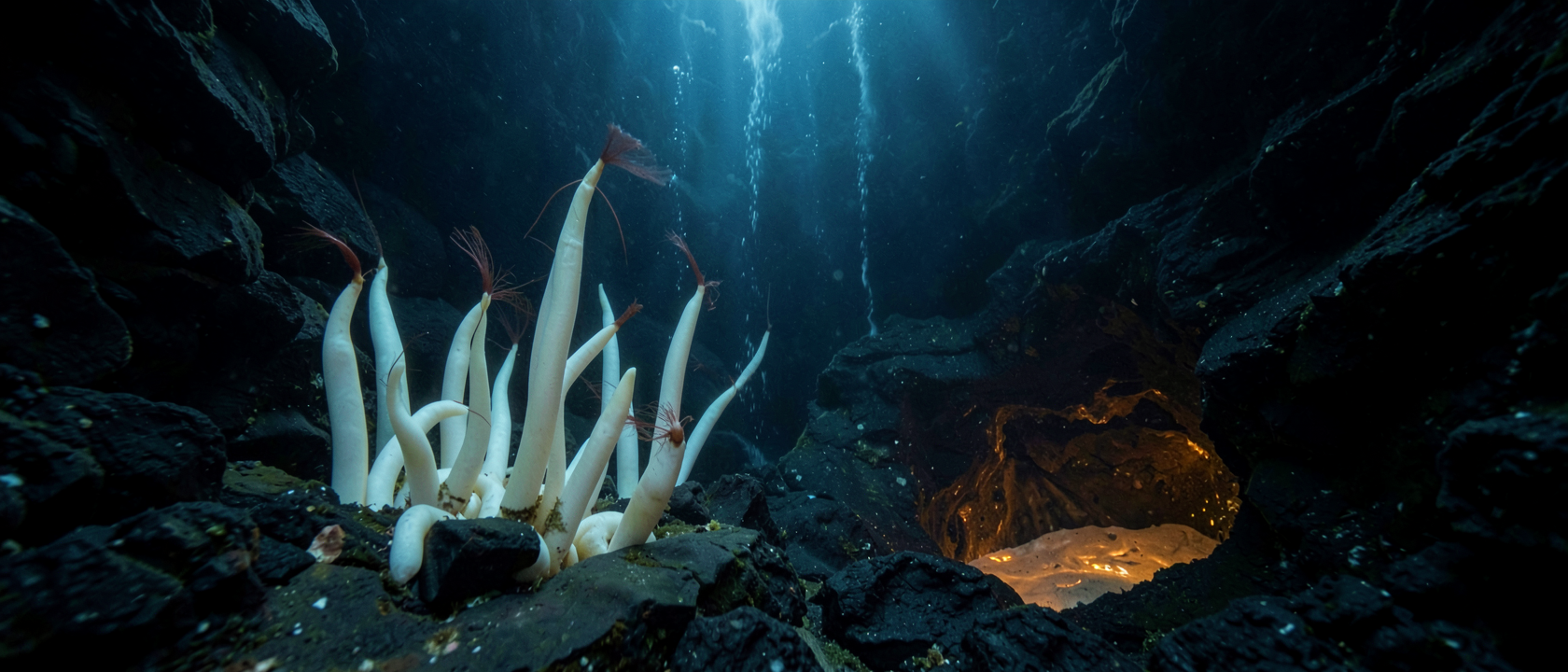
Giant tube worms are living, and apparently breeding, inside fluid-filled pockets sealed under slabs of hardened lava on the seafloor, a layer of the planet nobody had checked for animal life before. The finding comes from a paper published October 15, 2024, in Nature Communications, led by Monika Bright at the University of Vienna with Sabine Gollner, André Luiz de Oliveira, and twenty-one other co-authors, drawn from a 30-day expedition aboard the Schmidt Ocean Institute’s research vessel Falkor (too) in the summer of 2023. At a hydrothermal vent on the East Pacific Rise, near the Galápagos Islands, 8,250 feet (2,515 meters) below the surface, the crew used a remotely operated vehicle to drill into the seafloor and lift slabs of solidified lava. Underneath were cavities filled with hydrothermal fluid at about 75 °F (24 °C), packed with adult worms tucked into cracks nobody had opened before. Oasisia alvinae tubes ran up to 8 inches (20 cm) long. Riftia pachyptila tubes went past 19 inches (50 cm).
Adults, not just tenants
Inside one cavity, the team dissected two male R. pachyptila with testes full of sperm and two females with gonads full of eggs. Larvae drifting into a crack and getting stuck would be one kind of discovery. Sexually mature worms sitting in total darkness under a lid of hardened lava, actively producing eggs and sperm, is another. These animals had not just arrived. They had grown up down there, and by the evidence inside their own bodies, they were reproducing there too.
One habitat, not two
Marine biologists have long assumed that Riftia pachyptila and Oasisia alvinae larvae disperse the ordinary way, drifting through open seawater near the vents, though no one has ever actually recorded one swimming there. Bright and her co-authors now propose something else: that larvae might travel through cracks and seawater seeping into the ocean crust itself, following the same recharge pathways that feed the vents their hot fluid. If that idea holds up, the vent surface and the cavities beneath it are not two separate habitats. They are one connected system, a lattice of cracks and pockets a worm can move through and settle inside, whether that turns out to mean the open seafloor or several feet under it.
The myth this kills
The old assumption at hydrothermal vents was simple: the seafloor surface belongs to tube worms, mussels and crabs, while the shallow crust underneath belongs to microbes and viruses, a chemical soup with no room for animals. This finding throws that out. Full-grown, breeding tube worms were living inside solid rock cavities, not just coated in microbial film. Sabine Gollner, of the Royal Netherlands Institute for Sea Research and a co-author on the study, said in a video released around publication: “We want to understand how animals travel and how they disperse, so we looked for the first time into the subsurface.” She added, “Animals are able to live beneath hydrothermal vents, and that, to me, is mind-blowing.” The microbes were never the mistake in the old picture. The mistake was assuming they had the place to themselves.
What nobody has seen
The crack-dispersal idea is still an idea, not a confirmed route. Nobody has recorded a Riftia pachyptila or Oasisia alvinae larva swimming anywhere near a vent, at the surface or underground. So the open questions are basic ones: how far a larva could travel through the crust, how long it survives down there, and how it copes with the low oxygen inside those pockets. The researchers’ next questions go further out. Does this kind of subseafloor animal life exist at every hydrothermal vent, or only some? And how far do these cavities actually extend, sideways and down, under the lava we can already see? As the researchers themselves put it, this kind of subsurface biosphere for animal life is a field that has barely been opened.
The worm’s take
It took a research vessel, a remotely operated vehicle, and a hole drilled through solid lava for anyone to find what these worms seem to have worked out on their own long ago: a spot behind a lid of rock, warm, dark, and out of reach of the mussels and crabs crowding the surface above.