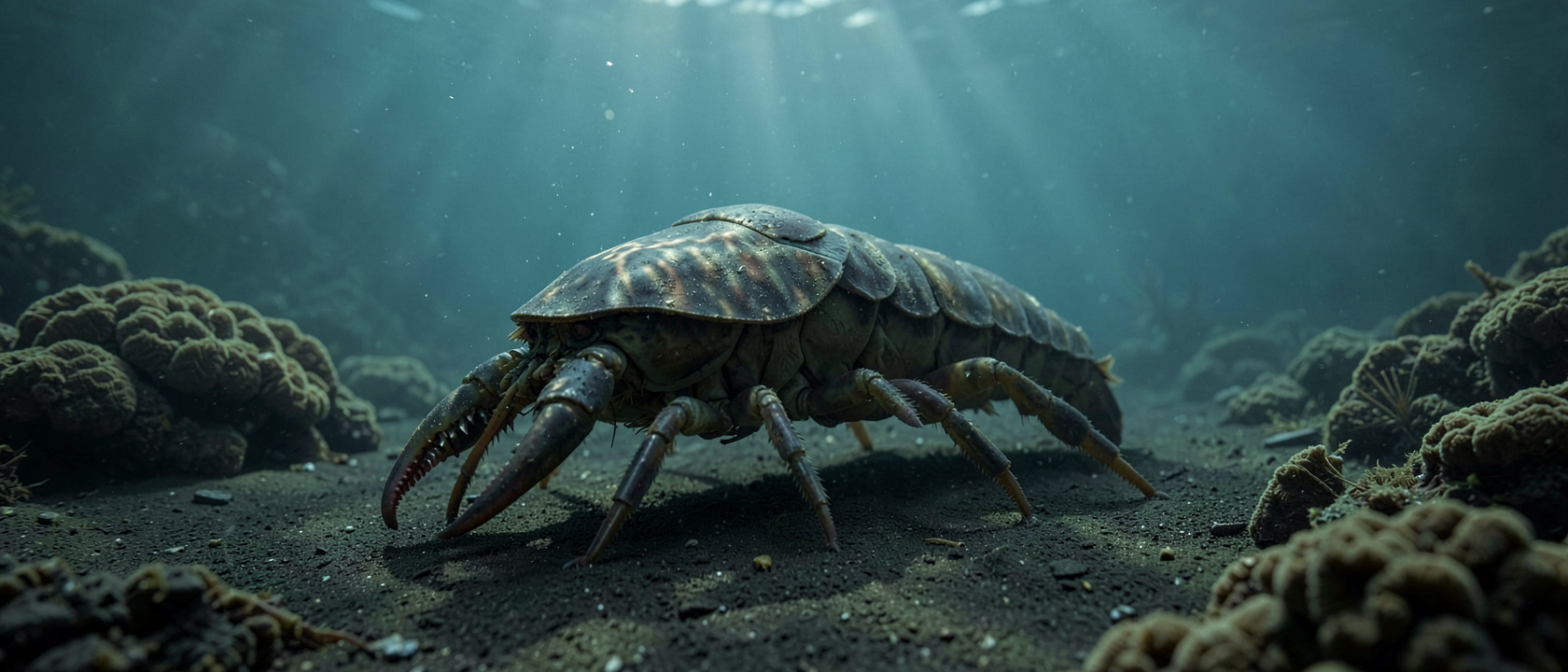
The Claw Where an Antenna Should Be
A claw sits exactly where an antenna is supposed to sit on a fossil pulled from Utah’s Wheeler Formation. That claw belongs to Megachelicerax cousteaui, a marine predator just over 3.1 inches (8 cm) long, described from a single specimen and now recognized as the oldest confirmed member of Chelicerata, the group that includes spiders, scorpions, horseshoe crabs, mites, and sea spiders. The animal lived around 500 million years ago, in the middle Cambrian. The pincer on its head is a true chelicera, the same grasping tool that still tips a spider’s fangs and sits on the front legs of a living horseshoe crab. In life, researchers estimate the animal reached about 3.9 inches (10 cm), since the fossil itself is missing its back end.
A Body Built in Two Halves
Under a microscope, the fossil gave up a head shield and nine body segments. The head shield carries six pairs of specialized limbs for feeding and sensing, and the underside of the trunk is lined with flat, plate-like structures that resemble the “book gills” still used by modern horseshoe crabs to breathe. The body has two clearly separate modules, a head unit and a trunk unit, rather than one blended structure, and that’s the same basic floor plan carried by every living chelicerate, from a garden spider to a horseshoe crab stranded on a beach at low tide. What makes the claw a chelicera and not just an oversized limb is its position: it’s the very first appendage on the head shield, directly observed on the specimen, sitting exactly where the defining pincer sits on every chelicerate alive today.
Why the Order of Evolution Matters
This fossil catches evolution mid-step. The chelicera and the two-region body plan came first; only later did the rest of the head limbs lose their outer branches to turn into the simple walking legs seen on living spiders. That sequencing settles a real disagreement among researchers over which trait in the chelicerate body plan appeared first. Megachelicerax cousteaui shows the pincer already in place before those legs were simplified, not the other way around, which places the species as a bridge between earlier Cambrian arthropods that lacked a clear chelicera and the younger, horseshoe-crab-like animals called synziphosurines that came after.
The Myth of the Cambrian Blank Spot
Before this fossil, the oldest confirmed chelicera-bearing animal came from Morocco’s Fezouata Biota, dated to roughly 480 million years ago, in the Early Ordovician. Plenty of researchers treated the Cambrian period itself as a blank spot for chelicerates, a stretch of time with no unambiguous member of the group. Megachelicerax beats that record by about 20 million years, and it does it with anatomy, not guesswork: a chelicera sitting right where the physical evidence says a chelicera should sit.
A second assumption falls with it. The idea that sophisticated anatomy should translate quickly into ecological success doesn’t hold up here. Chelicerates already had the full toolkit, head shield, chelicera, gill plates, 500 million years ago, and they still spent an enormous stretch of time as background characters while trilobites ran the Cambrian seas. Lerosey-Aubril has said this delay looks familiar from other branches of the animal family tree, though he didn’t specify which ones, so exactly why complexity and dominance arrived on such different schedules for chelicerates remains an open question. His own reading is that evolutionary success needs more than a good design; it needs the timing and the environment to cooperate too.
Cleaning a Fossil for Fun
The specimen had been sitting in a Utah fossil collection for decades. It was found by amateur collector Lloyd Gunther and donated to the Kansas University Biodiversity Institute and Natural History Museum in 1981, then filed among a batch of what paleontologist Rudy Lerosey-Aubril calls “seemingly unremarkable” Utah fossils that he offered to look through for unrelated research on early arthropods. It took him more than 50 hours of careful work under a microscope, with a fine needle, to clean it.
Here’s the story he tells about the moment itself: after a full day of teaching, he sat down with the fossil to unwind. It looked like a typical Cambrian arthropod until it didn’t. There was a claw sitting where an antenna belongs, and claws never sit there on animals from that period. By his own account, it took him a few minutes just to accept what he was looking at. He and his co-author, Harvard’s Javier Ortega-Hernández, later named the species after Jacques-Yves Cousteau, a fellow Frenchman whose work on ocean life they had both admired for years.