The Handstand Pee
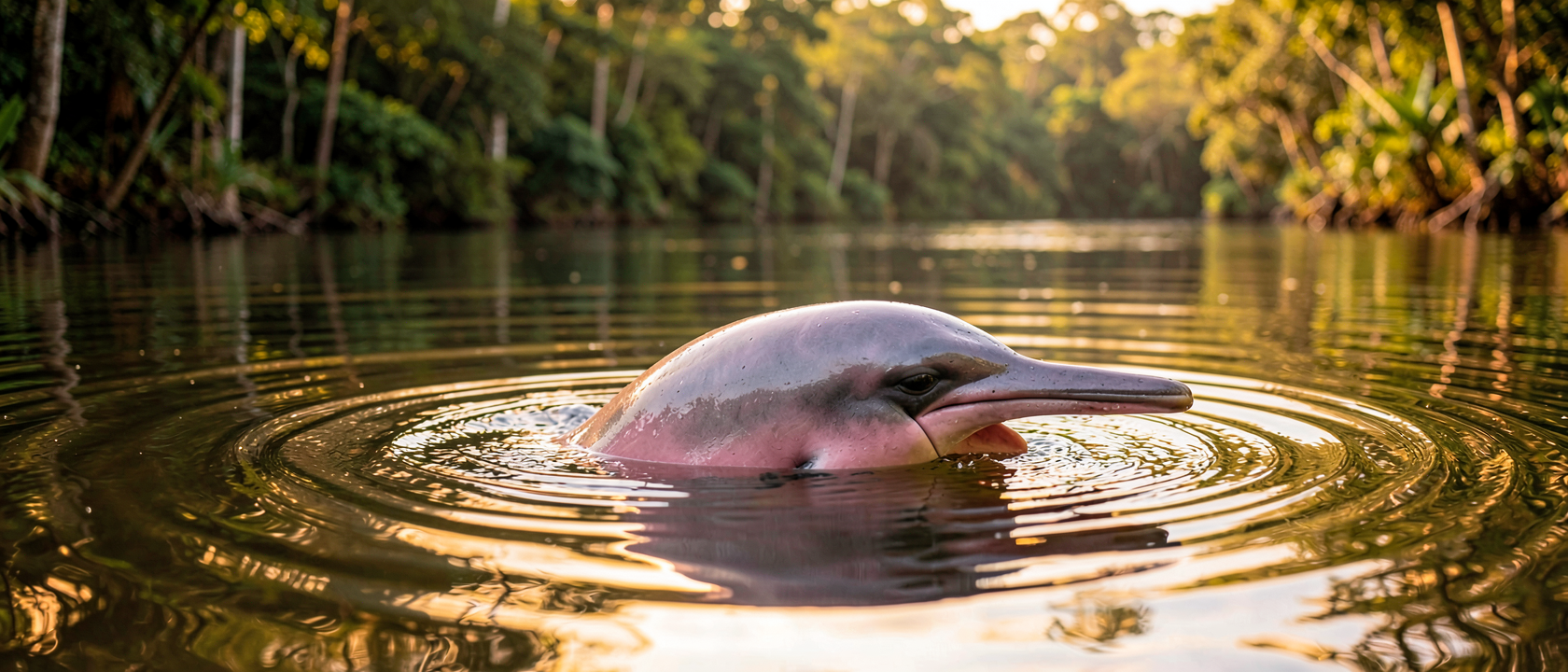
A male Amazon river dolphin rolls onto his back, lifts his penis clear of the water, and fires a jet of urine into the air, sometimes arcing it toward another male’s snout. Zoologist Claryana Araújo-Wang and colleagues from the Botos do Cerrado Research Project in Brazil and the CetAsia Research Group in Canada logged 218.9 hours watching wild Amazon river dolphins (Inia geoffrensis), and counted 36 instances of exactly this: a male flipping belly-up and shooting urine skyward, sometimes swimming in a straight line, a circle, or a zigzag as he goes. A second male, the “receiver,” was nearby in 67% of those events, often positioning his rostrum, the long, narrow beak river dolphins use to catch fish, right in the path of the stream. The population in this study is often described as its own species, Inia araguaiaensis; this piece uses the wider species name, Inia geoffrensis, the same one under which the behavior first reached a general audience. Published in the journal Behavioural Processes in 2025, the study turns those 36 events into something more than an accident caught on one lucky afternoon.
Why Taste Instead of Smell
Most mammals that mark with urine do it for a nose. Lions, tigers, and bears use it to hold territory; wolves and coyotes read it off scent posts; mice pick up chemical cues from a puddle other mice would simply walk past. All of that depends on smell. Amazon river dolphins do not have one: over evolutionary time, botos lost their sense of smell entirely, so any chemical information riding in that arc of urine cannot be read through a nose that isn’t there. It has to be tasted instead. That lines up with what the receiving male actually does: he does not sniff from a distance; he moves his rostrum straight into the stream. Rolling onto the back is not incidental either. It aims the jet up and out, into open air, exactly where another dolphin’s mouth can meet it midair instead of it dissolving uselessly into the river below.
What It Might Be Saying, or Not
Araújo-Wang’s working idea is that this is politics, not plumbing. Botos already show a set of male-to-male contest behaviors around mating, including aggression displays and carrying objects to impress or intimidate rivals. Aerial urination may belong to that same toolkit, a way for a male to advertise his condition or standing to another male rather than simply relieve himself. One detail carries a lot of weight here: in every recorded instance, both the urinating dolphin and the receiving dolphin were male. No female has ever been recorded on either end of it.
Not everyone buys the dominance reading, though. An independent commentary on the study has pushed back, arguing the available data are too thin to support either a status display or a sexual signal. Its authors think the simpler explanation is play, solo or social, the same impulse that has dolphins tossing seaweed or riding each other’s wakes for no obvious payoff. A behavior does not need a message to survive; sometimes it just needs to be fun enough to repeat.
Urine Signals Don’t Need a Nose
The quiet assumption behind most writing about scent-marking is that it requires a sense of smell, from a wolf’s scent post to a cat rubbing its cheek against a doorframe. Botos break that assumption: they appear to run the same kind of chemical-signaling job through an entirely different sense. Bottlenose dolphins may do something similar. A separate 2022 study by Jason Bruck at Stephen F. Austin State University found that they can identify individual dolphins they already know by tasting their urine. Two dolphin lineages, one oceangoing and one confined to rivers, and in both cases a job assumed to belong to the nose turns out to belong to the tongue.
Signal, Display, or Just a Thing They Do
Nobody has shown that the urine itself carries information a receiving dolphin can act on. The researchers stop short of that claim, describing the behavior as likely serving some social function beyond waste elimination without pinning down what that function is. It could be a genuine chemical signal, read by taste rather than smell. It could be a purely visual display, where being seen doing it in front of a rival matters more than anything in the liquid itself. Or, as the play critique suggests, it might be neither, just something botos do because it feels like something to do. Testing any of this with a controlled taste-preference trial is easy enough in a captive setting and close to impossible with a wild, free-ranging river dolphin.
Jason Bruck, who was not involved in the study, raises a separate question that nobody has answered either: if pollution is changing the chemistry of these rivers, or of the dolphins’ own urine, nobody knows whether it’s already disrupting a signal that science hasn’t even confirmed exists.
Bruck Already Had the Slide
Bruck did not need convincing the behavior was real. He says he has kept a slide of a river dolphin doing exactly this, belly-up, mid-arc, in his lecture materials for years, a known oddity that circulated among dolphin researchers as a half-joke long before anyone counted it 36 times. The new tally, he says, gives the old joke “a solid foundation,” adding: “It’s not a one-off.” Two versions of the same fact, one carried as a story between colleagues, the other as data in a journal, arriving at the same place.