One Season’s Fat, Burned in a Single Migration
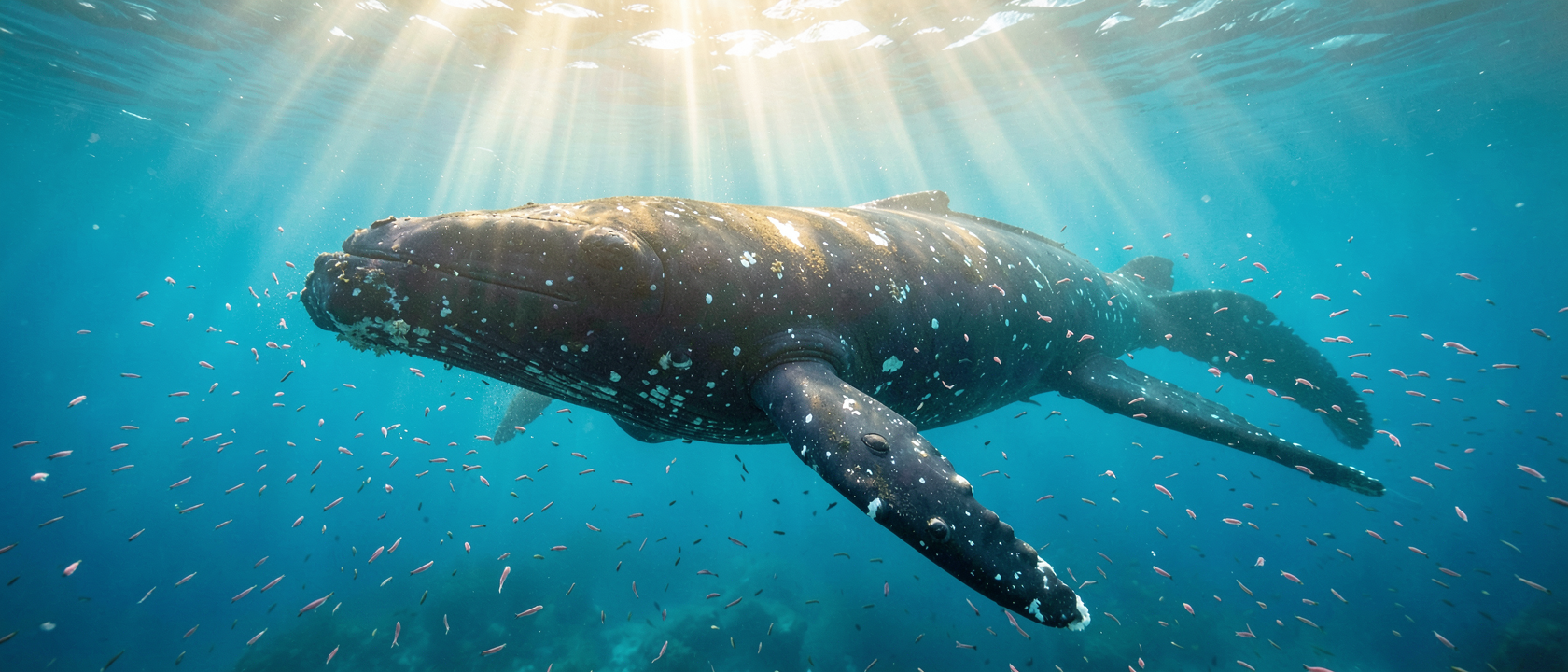
A southern hemisphere humpback whale (Megaptera novaeangliae) can lose about 36% of its body condition on a single round trip between its Antarctic feeding grounds and its breeding grounds in Colombia. That number comes from a team led by Alexandre Bernier-Graveline, a PhD candidate at Griffith University, working with researchers from Aarhus University, UC Santa Cruz, and Universidad de los Andes, published in *Marine Mammal Science*. The team flew drones over 103 adult whales from breeding stock G and used the images to measure body condition, a technique called photogrammetry, essentially reconstructing an animal’s shape and volume from photographs, at both ends of the journey.
In raw terms, that 36% works out to about 24,250 lb (11,000 kg) of blubber, gone. Converted to energy, it’s 196 million kilojoules per whale, which the researchers note is roughly what an average adult human eats over 62 years. It also equals the energy the whale would get from about 125,660 lb (57,000 kg) of Antarctic krill. Adult humpbacks can grow to 43 feet (13 m) and weigh close to 39 short tons (35,000 kg). That’s a lot of animal to run on empty.
Fill Up in March, Coast on Empty by December
The whales bank almost their entire fuel supply before they leave. Bernier-Graveline’s team found humpbacks are at peak body condition between early March and late May, right after the Antarctic krill season, feeding heavily off the Western Antarctic Peninsula, one of the most productive patches of ocean in the Southern Ocean. From there they head north to Colombian waters to mate and calve, and along the way they eat, effectively, nothing.
Every kilojoule spent swimming, competing for mates, and nursing a newborn calf comes straight out of fat reserves laid down months earlier and thousands of miles south. By the time the whales get back to Antarctic waters, sometime between late August and early December, they are at the leanest point of their whole year, arriving just as the krill are ready to start refilling them.
The Whale’s Whole Year Is Downstream of One Krill Season
This is not just an endurance stat. A humpback whale’s entire reproductive year rests on the success of one Antarctic feeding season. There is no midway refueling stop between the Peninsula and Colombia, and no backup plan if the krill run thin. “Southern hemisphere humpback whales depend on Antarctic krill for their annual energy requirements, fueling their long migrations between feeding and breeding grounds,” Bernier-Graveline said.
That dependence is where the 36% figure gets its teeth. A poor krill season doesn’t just leave one whale hungrier in April, it means the entire population starts its next migration already in the red, before a single mile of swimming happens. Bernier-Graveline has said that with the Antarctic sea-ice ecosystem changing quickly, knowing exactly what migration costs gives scientists a baseline for watching whether the whales can keep up with those changes.
36% Is an Average, Not a Sentence
What the study does not do is turn that baseline into a forecast. It does not say how an actual krill shortfall, from warming water or heavier fishing pressure, would show up as fewer calves or higher deaths in breeding stock G. Griffith University’s own description of the work calls it “key ecological context,” not a finished population model.
The 36% is also an average across all 103 whales measured, with no breakdown by sex, age, or reproductive status. A pregnant female nursing a newborn calf and a young male competing for mates are almost certainly not paying the same price for the same migration, but the current dataset does not separate them. The research has measured the size of the bill precisely. Which whales are least able to pay it is still an open question.