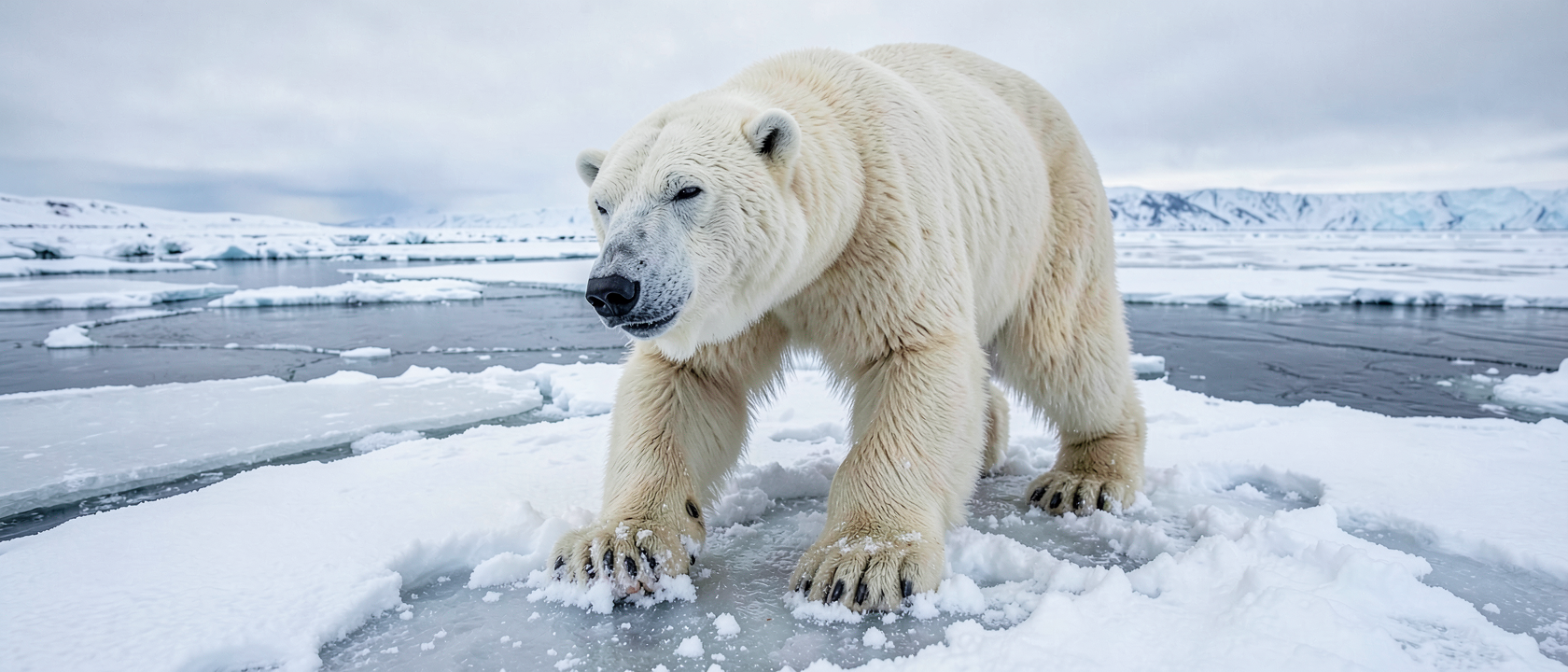
The Feet That Ice Built Are Getting Iced
Polar bear (Ursus maritimus) foot pads are covered in small bumps built for one job: grip on ice. Now that same surface is collecting something else. Slabs of ice up to a foot across (30 centimeters) are freezing directly onto the skin of the pads, not tangled in fur but sealed onto the pad itself. When the ice comes off, researchers find hairless patches, open cuts, and scar tissue underneath. Some of the bears affected can barely walk.
Sixty-One Bears, One Basin, a Decade of Looking
Kristin Laidre, at the University of Washington, and wildlife veterinarian Stephen Atkinson examined two wild populations from 2012 to 2022: Kane Basin, the stretch of sea ice between Canada and Greenland, and East Greenland, farther up the coast. Their paper, published in the journal Ecology on October 22, 2024, found icing-related injuries, hairless patches, cuts, or scarring, in 31 of the 61 bears examined in Kane Basin and 15 of the 124 bears examined in East Greenland. Within Kane Basin, between 2012 and 2013 alone, 73% of adult males showed the damage. Both populations have been monitored since the 1990s. Nobody studying them had documented this particular injury before.
The Bumps Were the Whole Point, That’s the Problem
Brown bears and black bears have foot pads too, but polar bear pads carry larger bumps, built to hold the animal steady on a frozen ocean. The trouble is that the same texture grips wet snow just as well as it grips ice, and slushy snow packs into those bumps and stays. Laidre and Atkinson don’t claim to have proven the cause; what they offer are three proposed conditions, all tied to a warming Arctic, that could plausibly turn that packed snow into a solid block. One hypothesis: rain falling on snow instead of more snow falling on snow, leaving a slushier mix behind. Another: warm spells that melt the surface and let it refreeze into a hard crust, one the bears’ own weight breaks through, cutting their paws on the sharp edges. A third: seawater seeping up through thinning fast ice near where glaciers meet the ocean, soaking the snow layer above it. Any of these, the authors suggest, could leave slush frozen onto a paw, though the study doesn’t separate which mechanism is doing the most damage. A fourth detail makes things worse regardless of cause: bears in these two populations rarely swim long distances in spring, unlike some other polar bear groups, so the warmer water that might otherwise wash the ice loose never gets the chance. The same buildup has reportedly shown up on sled dogs working across the Arctic, though this study did not examine them.
The Feet Are a Symptom, Not the Story
A separate study by Melinda Webster, also at the University of Washington, tracked snow cover on Arctic sea ice and found less of it in late spring and summer, with melting that starts earlier, arrives in fits and starts, and comes with more rain than it used to. That is the exact weather recipe the icing study describes. The paw injuries are not an isolated ailment picked up by chance. They look like a shift in Arctic weather patterns, showing up as a wound on one animal’s skin, visible only because someone happened to be sedating that bear for research.
A Different Kind of Damage From the One You’ve Heard
The familiar version of this story says a warming Arctic hurts polar bears by melting the platform they hunt seals from: less ice, less hunting time, thinner bears. That mechanism is real, and it is not what this study describes. Laidre and Atkinson found something else: ice that is still present, still under the bears’ feet, and still injuring them directly. This isn’t a shortage of ice. The ice is there. It’s just doing something new to the animal standing on it.
Two Bears, 2022, Neither Could Run
In 2022, researchers found two bears in East Greenland, at separate locations, each with an ice block up to a foot across sealed to the skin of its foot pads. Laidre has said she had never seen anything like it. When the team immobilized the bears for study and worked the ice loose, carefully, both animals flinched when their feet were touched. Neither could run. One could barely manage a walk.
Nobody Knows Yet What This Does to the Population
What remains unanswered, and Laidre has said so plainly, is what any of this means beyond the individual bears examined: whether it affects survival, reproduction, or how far the problem reaches across the wider Arctic. The three proposed causes, rain on snow, refreeze crusts, and seawater rising through thinning ice, haven’t been separated from one another either. It may be one of them driving most cases. It may be all three, stacking every time.