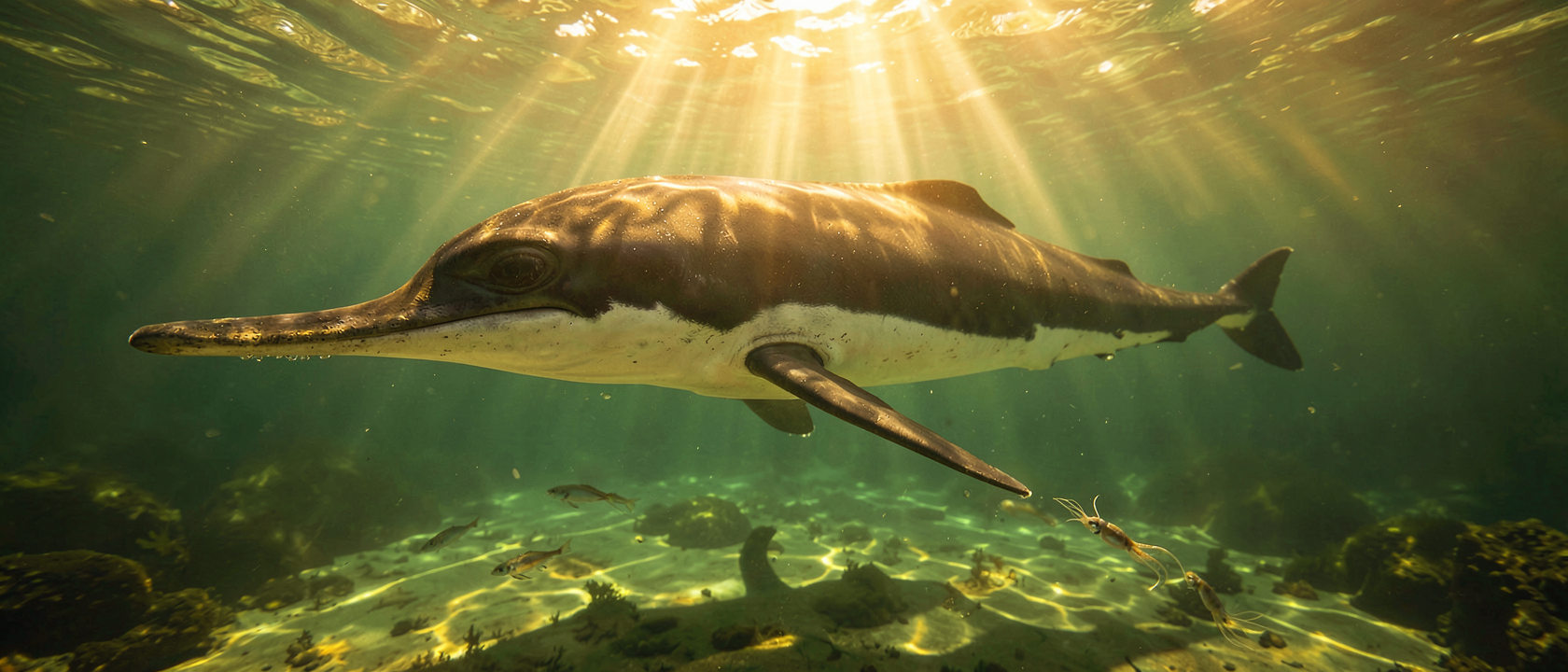
The Sword Dragon of Golden Cap
A 10-foot (3-meter) marine reptile that patrolled the seas off what is now Dorset, England, about 183 million years ago has a formal name. In a study published October 9, 2025, in the journal Papers in Palaeontology, paleontologists Dean Lomax, Judy Massare, and Erin Maxwell described it as a new genus and species: Xiphodracon goldencapensis. That’s the same formal process, governed by the rules of zoological nomenclature, that produced Tyrannosaurus rex.
The genus name is built from Greek: xiphos for “sword,” drakon for “dragon,” a nod to the old habit of calling ichthyosaurs “sea dragons.” The species name honors Golden Cap, a landmark on the 96-mile (154-kilometer) Jurassic Coast where fossil collector Chris Moore found the skeleton in 2001, nearly complete, in outcrops of the Charmouth Mudstone Formation. Its skull earns the sword: a long, narrow, blade-shaped snout and eye sockets oversized even by ichthyosaur standards. The describing paper also flags a small bone around the nostril, the lacrimal, carrying odd prong-like protrusions never documented in any other ichthyosaur. This is, per the paper, probably the most complete prehistoric reptile known from the Pliensbachian stage of the Early Jurassic (roughly 193 million to 184 million years ago), and the first Early Jurassic ichthyosaur genus described from the region in more than a century.
A Body That Tells Two Stories
The skeleton, catalogued as ROM VP52596 at the Royal Ontario Museum, holds evidence of how this animal died. Co-author Erin Maxwell, curator of fossil aquatic vertebrates at the State Museum of Natural History Stuttgart, points to two different signatures in the bone. The limb bones and some teeth are malformed in ways consistent with an old injury or disease, damage a living body has time to react to. The skull, by contrast, carries bite marks with no such reaction: wounds inflicted at or near the time of death, never healed. That contrast turns scattered damage into a sequence: this animal was already weakened, and something with a much bigger bite killed it.
Researchers think the biter was likely another, larger ichthyosaur. One name floated for the role is Temnodontosaurus, a genus that could grow past 33 feet (10 meters), plenty big enough to make quick work of a 10-foot animal. That identification is speculative, not confirmed. What the bite pattern and healed malformation do support, together, is a probable cause of death: sick or hurt first, killed second.
One Skeleton, a Moved Timeline
Ichthyosaur faunas from before the Pliensbachian and from after it are both known from abundant, often complete fossils, and they’re strikingly different casts of species. Of the genera swimming before the Pliensbachian, only one made it into the following stage, the Toarcian, and not a single species crossed that line. Something replaced almost the whole ichthyosaur community during the Pliensbachian, and the open question is when.
This is where Xiphodracon goldencapensis earns its keep. Lomax argues that its anatomy, in the skull and limbs, sits closer to species known from later in the Early Jurassic than to species from earlier in the Pliensbachian. A single well-preserved animal can do that kind of work because its traits act as a dated fingerprint: if a feature normally shows up only in younger faunas, and this specimen already carries it earlier than expected, the turnover it belongs to must have started sooner than the fossil record previously suggested. Lomax’s reading points to the shift beginning earlier in the Pliensbachian than paleontologists had assumed, one researcher’s argument, built from anatomy on a single specimen, not yet a settled date.
The Turnover Nobody Can Explain
Ichthyosaur fossils are common on both sides of the Pliensbachian boundary, yet fossils from inside the transition itself are rare, and this specimen ranks among the most complete ever recovered from that narrow window. Xiphodracon goldencapensis can help mark when the changeover happened. It can’t say why.
No cause has been established. Not climate, not sea level, not a collapse in prey. The Pliensbachian falls only about 10 million years after the end-Triassic mass extinction, a critical stretch for how these fast-swimming predators diversified afterward, and it remains, in the researchers’ own framing, a poorly understood one. The shape of the mystery is clear: a near-total changeover in species, sitting inside a window where fossils are unusually scarce. The explanation isn’t.
Fifteen Years in a Drawer
Chris Moore found the skeleton on the Jurassic Coast in 2001 and sold it to the Royal Ontario Museum shortly after. Then it waited. Dean Lomax says he first laid eyes on it in 2016, fifteen years after it came out of the ground, and his first impression wasn’t “this is a new species that will help redate part of the ichthyosaur timeline.” It was simpler: it looked unusual. The paper naming it didn’t appear until 2025.
The gap is the point. The rock gave up this animal in a single stretch of collecting in 2001. Recognizing what it actually was took someone standing in front of it, years later, willing to look hard at a fossil already catalogued, shelved, and moved past. The skeleton is set to go on public display at the Royal Ontario Museum in Toronto. Anyone walking past it will be looking at an animal whose species was decided not on the cliffs of Dorset, but in a museum collection, more than a decade after it left them.