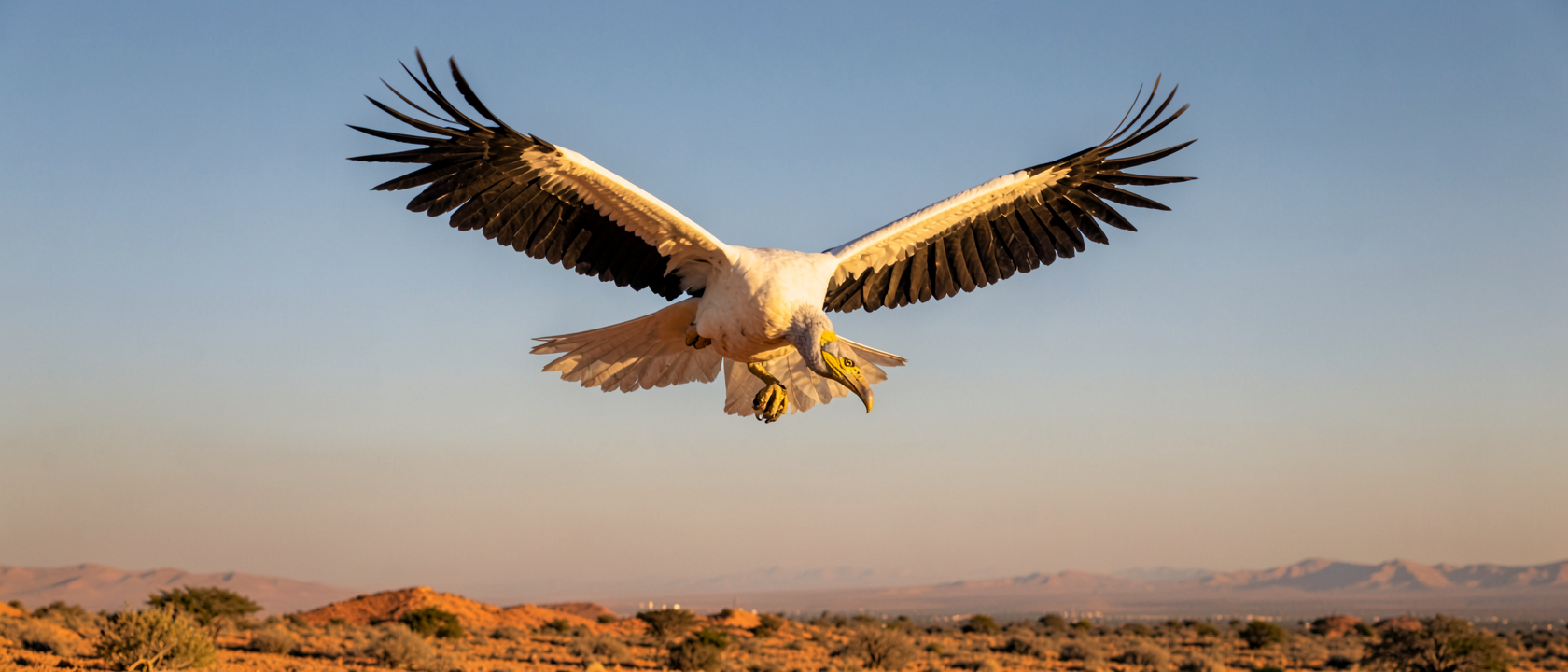
Raise an Egyptian vulture (Neophron percnopterus) chick by hand instead of by wild parents, and it will fly worse on its first trip south. Track it a second time, and you cannot tell it apart from a bird that never spent a day in captivity.
Raised by Hand, Flies Like It
A team from Ben-Gurion University of the Negev, working with the University of Haifa, fitted solar-powered GPS transmitters to 65 Egyptian vultures tracked across Israel between 2013 and 2022. The tags logged both position and body movement. Together the birds produced 127 tracked autumn migrations, split between two groups: vultures raised in captivity and released, and vultures raised in the wild. On the first migration, the study, published in Current Biology in 2023 by Ron Efrat, Ohad Hatzofe, Thomas Mueller, Nir Sapir, and Oded Berger-Tal, found the captive-raised birds clearly behind. They made shorter daily progress, they soared and glided on thermals less efficiently (thermals are rising columns of warm air that soaring birds ride instead of flapping), and their trip took roughly 4.1 days longer, on average, than a wild-raised bird’s own first migration. The researchers report that gap as statistically significant.
Second Flight, Same Bird Statistically
By the second autumn migration, that gap was gone. Captive-raised vultures matched wild-raised vultures on the same measures: migration duration, daily progress, soaring-gliding efficiency. Both groups improved with experience, which is unremarkable on its own; young raptors are supposed to get better at reading wind. What stands out is that the captive-raised birds improved by a bigger margin between migration one and two than the wild-raised birds did. They were not merely catching up. They closed a real deficit in a single trip.
Nature Sets the Start, Experience Moves the Bird
The paper treats this as two separate forces. Early-life environment (wild parents and wild flying conditions versus a hand-reared substitute) sets where a bird starts. Accumulated experience, meaning the hours actually spent riding thermals and reading terrain on real migrations, is what moves the bird from that starting point afterward. It works something like an adult learning a language later in life. The late start makes the early going harder, but it does not lower the ceiling. It just delays the part where things click. Berger-Tal, one of the study’s authors, put the underlying idea plainly: birds, like people, carry the shape of what they have lived through.
Why the Gap Is Allowed to Close
Egyptian vultures are one of the more actively reintroduced birds of prey across Europe and the Middle East, which makes this finding more than a curiosity. Raising chicks by hand and releasing them is a real conservation tool for this species, not a hypothetical. If captivity baked in a permanent flight deficit, every release program would be sending out vultures built to migrate worse for life. That the deficit disappears by the second migration matters for exactly that reason. For this specific skill, an early handicap is not a fixed sentence. A related 2022 study by the same research group found no difference in survival between the two groups over their first two years, tracking 44 captive-bred and 26 wild-raised vultures, respectively, which fits the same picture. The early gap costs something in flying skill. It does not appear to cost the bird its life.
What This Overturns
The natural guess is that a vulture raised without wild parents, without the trial and error of watching adults ride real wind as chicks, would carry that gap for life, having missed some window that only opens once. This study says otherwise. One full migration’s worth of real flying was enough to erase the difference entirely, not just narrow it. The bird does not just get better with practice; it gets all the way there, and it does it in a single trip. That is the part that should surprise anyone who assumes an early setback is destiny, for a bird or otherwise.
The Unanswered Part
The study measures the outcome, not the exact skill being relearned. It does not say which specific flight decisions changed between the first and second migration: better thermal selection, better route choice, better timing, or some mix of the three. It also does not say whether the catch-up holds beyond the second migration, or whether the age at which a captive-bred bird is released changes how fast it catches up. A separate tracking project on Egyptian vultures wintering on Crete has suggested that reduced first-migration flight efficiency in captive-bred birds might explain why some linger on the island instead of continuing south, but that link is offered as a possible explanation, not a confirmed one. Later learning, in this species, is clearly harder than an ordinary start. How it works, and how far it goes, is still open.