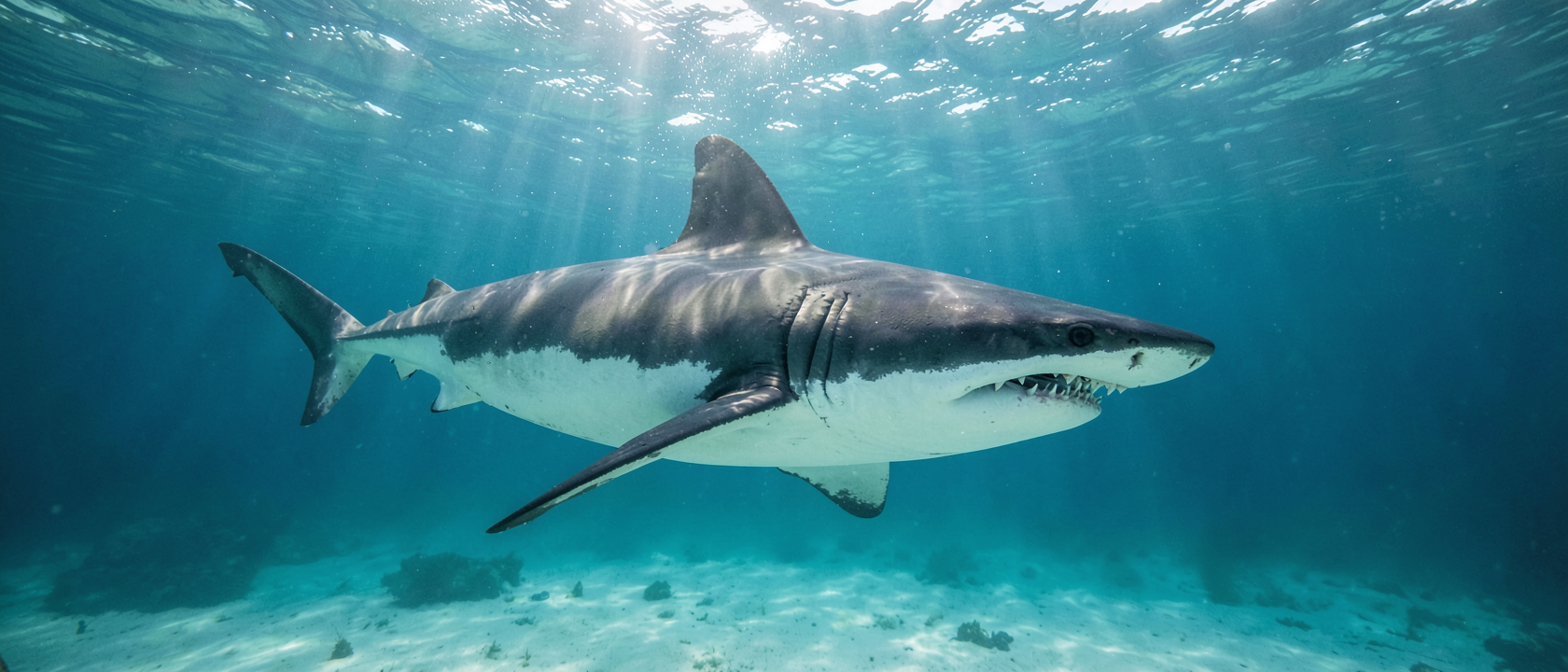
The livers keep washing up missing
Eight great white sharks have washed ashore near Gansbaai, South Africa, since 2017. Seven were missing their livers. A couple had lost their hearts too. Somebody figured out exactly which organ was worth the trouble, and it wasn’t a fisherman.
Before 2017, great whites (Carcharodon carcharias) had only abandoned this stretch of the Western Cape twice, and briefly: one week in 2007, three weeks in 2016. What started in 2017 hasn’t looked like either. It has run for years at a stretch, longer than anything on record at the site.
Two adult male orcas (Orcinus orca) are behind it, first recorded off Cape Town in 2015 and identifiable by their dorsal fins, one collapsed to the left, one to the right. A Cape Town whale-watching operator, David Hurwitz, named them Port and Starboard. The identification matters: ecologist Salvador Jorgensen found that other orca pods had passed through False Bay before Port and Starboard without triggering anything close to this exodus. This isn’t orcas, generally. It’s these two, specifically.
How you take a liver out of a great white shark
Biologist Ingrid Visser has documented the technique. An orca rams the shark side-on, flips it upside down into tonic immobility (a trance-like paralysis sharks fall into when inverted), grips a pectoral fin, and shakes until the liver tears loose. It reads like a stunt. It’s a routine.
A 2022 study led by Alison Towner at the Dyer Island Conservation Trust, published in the African Journal of Marine Science, combined years of sighting records with GPS tracking on 14 great white sharks over five and a half years. Whenever Port and Starboard showed up, the tracked sharks didn’t drift off in ones and twos. They left together, and visual sightings in some Western Cape bays collapsed.
The pattern has repeated with unsettling precision. On June 18, 2023, off Mossel Bay, Starboard worked alone on a juvenile white shark about 8.2 feet (2.5 m) long: gripping the left pectoral fin, thrusting into it several times, and eviscerating it in under two minutes. He was seen afterward carrying the liver past a boat. In February 2023, beachgoers near Pearly Beach found 20 carcasses torn open at the pelvic girdle, rake marks matching orca teeth, livers gone: 19 broadnose sevengill sharks (Notorynchus cepedianus) and one spotted gully shark. Port and Starboard had been sighted in the area three days earlier. A method used over and over stops being a coincidence.
Why the liver, specifically
A great white’s liver is enormous and oil-rich, the shark’s onboard fuel tank for its long migrations. A related paper in the journal Ecology calculated that an adult male orca’s entire daily energy requirement is roughly what it would get from the liver alone of a single 428-kilogram (944 lb) white shark. One kill covers a day’s food.
Towner has compared the sharks’ reaction to what ecologists call a landscape of fear: prey reorganizing where it will and won’t go because of a risk it can sense, not because the predator happens to be standing in front of it. The great whites of Gansbaai aren’t waiting around to find out. They leave before it happens, managing risk on a map only they can read. Feels like an unusual habit for the animal most people would still call the ocean’s apex predator.
It wasn’t overfishing
For years, the vanishing act at Gansbaai got blamed on people: overfishing thinning out what great whites eat. The 2022 tracking data points somewhere else entirely. The sharks aren’t being starved out of the area. They’re being hunted out of it, and the same withdrawal shows up elsewhere: off California’s Farallon Islands, white sharks disappear for months at a stretch once orcas move in.
With the great whites gone from Gansbaai, copper sharks (Carcharhinus brachyurus) have moved into the hunting grounds left empty. Port and Starboard have followed them there. Reports of the pair going after copper sharks, and even ocean sunfish, began not long after they were first recorded working False Bay.
What nobody knows yet
Nobody knows how Port and Starboard learned that a shark’s liver, of all things, was worth the effort, or whether the technique could spread to orcas that have never tried it. Most kills never wash ashore, which means the eight strandings on record are very likely a small fraction of how many great whites this pair has actually taken.
What happens further down the food chain once great whites disappear for years at a time is also unresolved. Researchers have raised the possibility of Cape fur seals, no longer kept in check, preying more heavily on endangered African penguins, and of kelp forests declining as abalone populations shift underneath them. Towner’s own team calls both a hypothesis that still needs testing, not a finding.