Bruce Never Loses
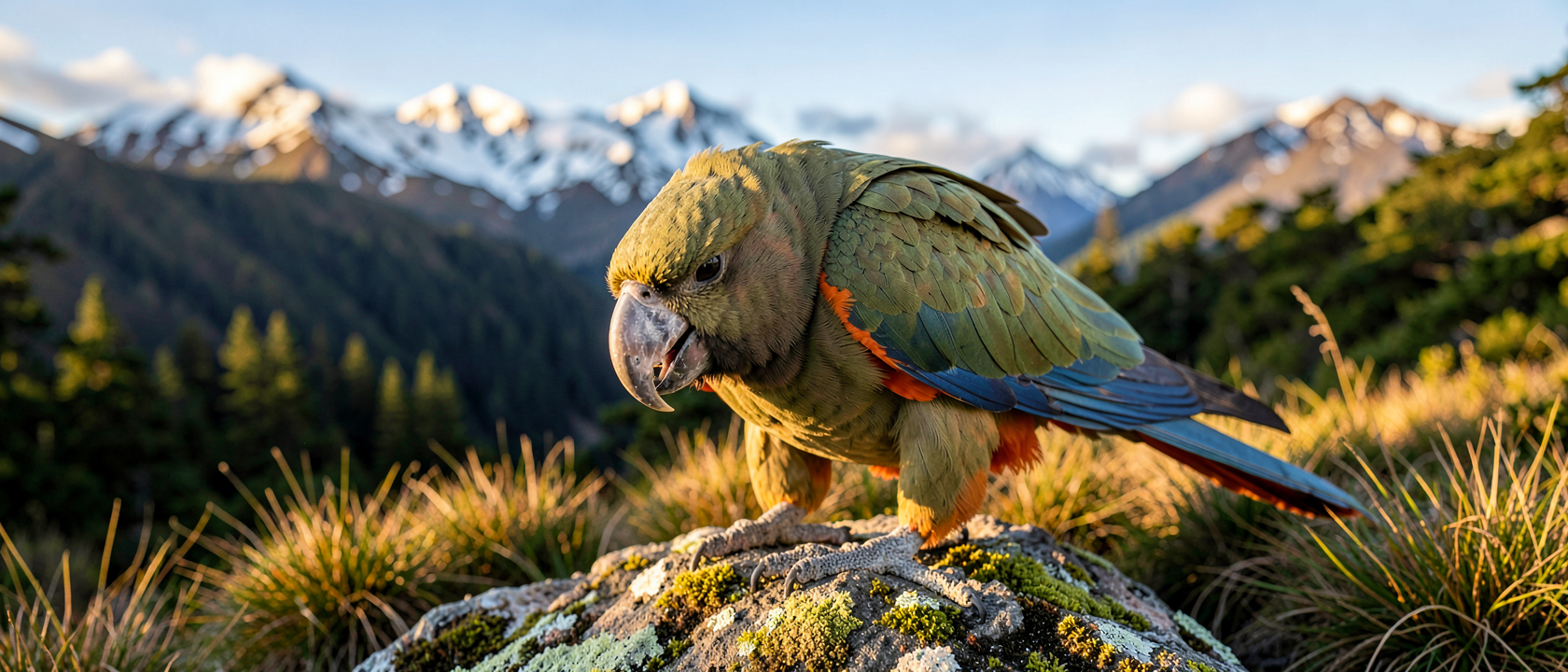
Bruce, a kea (Nestor notabilis) at Willowbank Wildlife Reserve on New Zealand’s South Island, was born without an upper beak, and he is the undisputed alpha of his twelve-bird group, known among kea researchers as a circus. Over a four-week observation period, researchers tracked 227 social and aggressive interactions inside the aviary. Among 162 recorded fights between the circus’s nine males, Bruce took part in 36 separate skirmishes and won every one. At feeding time he eats first and alone, while the other eleven birds wait their turn. Kea hierarchies are usually unstable, with individual ranks shifting as birds test and retest each other, and the researchers watching this circus saw exactly that kind of movement among the other eleven. Bruce’s spot at the top never moved.
A Spear the Others Can’t Build
Kea normally settle disputes with a kick, and Bruce kicks too. But his real weapon is the beak he doesn’t have. He crouches, takes a running start, and leaps at an opponent with his chin jutting forward like a spear, aiming for a wing, a leg, or a face, sometimes with enough force to nearly topple himself. Researchers who filmed 109 of these encounters found that jousting repelled an opponent 73 percent of the time, against 48 percent for a kick. No other bird in the circus can copy the move, and the reason is anatomical, not behavioral. A kea’s upper beak is a long, curved hook that overlaps and locks against the lower beak at rest, so an intact kea physically cannot bring its own lower mandible forward into a point. Bruce has no upper beak left to do the locking. The structure that would make him a normal, functioning kea is exactly the structure his rivals can’t get rid of.
Why the Calmest Bird in the Room Runs It
A joust that decisive doesn’t need repeating often, and that may show up in Bruce’s body chemistry. Researchers measured corticosterone, a stress hormone, in droppings collected from all twelve kea in the circus. Going into the study, the prediction was that the most dominant, most challenged bird would carry the highest levels. Bruce had the lowest corticosterone of the entire group instead. The study’s authors propose that a rank held almost entirely by reputation costs less than one that has to be defended by constant fighting: because Bruce’s move is unbeatable, he rarely has to use it.
“Disabled Means Disadvantaged”? Not in This Aviary
The assumption that a parrot missing the beak it uses to climb, dig, grasp, and pry should sit at the bottom of a hierarchy, not the top, is exactly what the Current Biology study contradicts. The paper, led by University of Canterbury post-doctoral fellow Alexander Grabham and published April 20, documents an animal that didn’t just survive its missing structure; it built a fighting style out of it. The jousting is only the most visible part. Bruce selects sharp stones and uses them to preen himself, a job every other kea does with its own beak. He grinds food into pulp against rocks, fence posts, or human feet instead of chewing it in the ordinary way. And as alpha, he gets other males to groom him, including picking debris out from around his exposed lower beak, a service kea normally reserve for mates, not rivals. Researchers found that the lower a male’s rank in the circus, the more likely he was to be the one doing that grooming. None of it reads like an animal being accommodated. It reads like an animal that solved several separate problems and then put the fixes to work.
What Nobody Knows Yet
Two questions stay open. How Bruce lost his upper beak in the first place is unknown; he was already missing it when he was found in the South Island mountains in 2013, and there is no record of whether it was a birth defect, an injury, or a predator encounter. Researchers also flag a more practical uncertainty closer to home: kea circuses are usually fluid, with birds joining and leaving through the year, and tougher winter food might test Bruce in ways summer feeding never has, so whether his rule holds up long-term is genuinely unknown. The source material also flags one adjacent case worth naming without leaning on it: a cow named Veronika reportedly used a stick to scratch an itch. That is a single reported case, not evidence that cattle improvise tools, and it proves nothing about kea. It just means the real range of this kind of innovation is still unmeasured.
Bruce Used to Be Kati
When bird expert Raoul Schwing found the beakless kea in the mountains of Arthur’s Pass in 2013, the bird was small enough that he assumed it was female and named it Kati. Kati was brought into captivity because a kea missing its upper beak was judged unlikely to survive an alpine winter on its own. Genetic testing later showed that the future alpha of the Willowbank circus, the bird that would go on to win every recorded fight and eat first at every meal, had been male the whole time. Kati became Bruce.