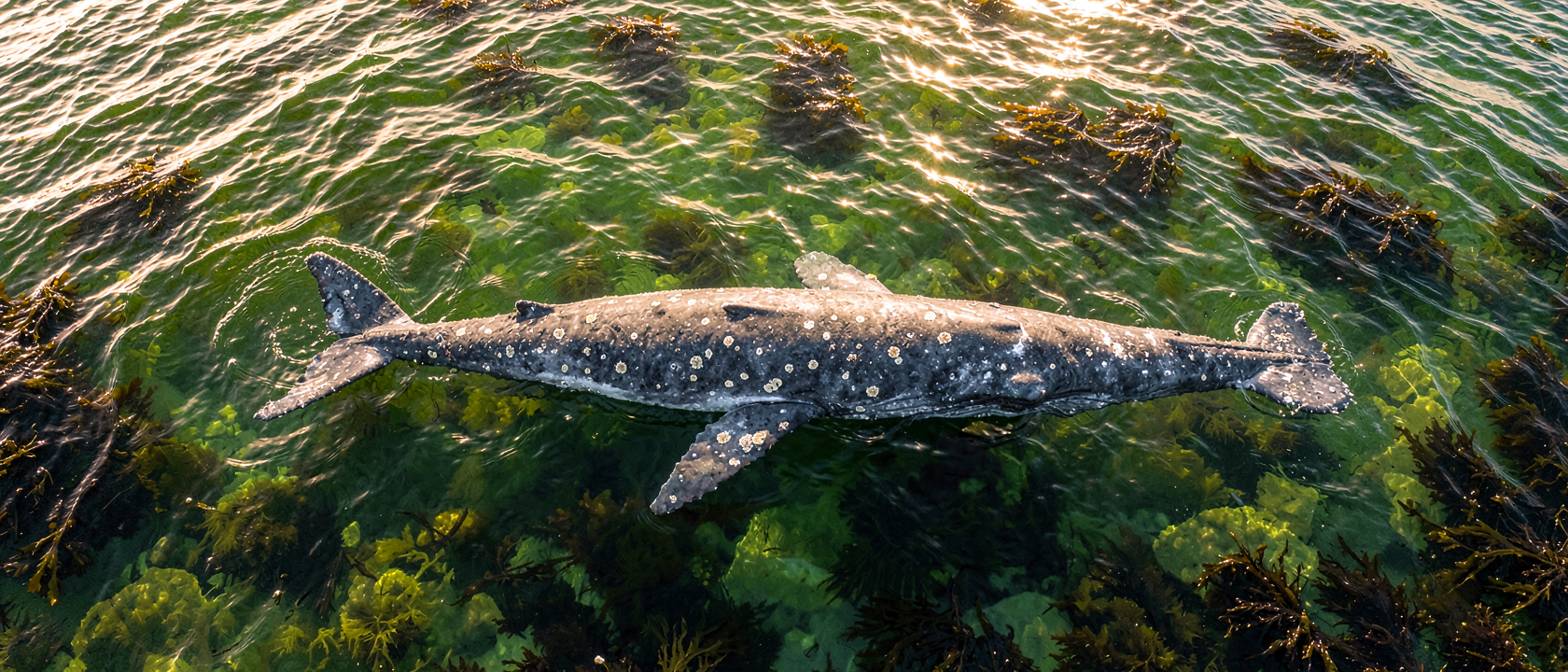
The Whale That Won’t Get as Big
A gray whale (Eschrichtius robustus) born in 2020 is projected to grow into an adult about 5 feet 5 inches (1.65 meters) shorter than one born before 2000. For a population that normally matures to 38 to 41 feet (11.6 to 12.5 m), that is a loss of more than 13% of total body length in two decades.
The number comes from Oregon State University’s Marine Mammal Institute, working with researchers at the University of St. Andrews, published in Global Change Biology in 2024 and led by Enrico Pirotta and K.C. Bierlich. Their team flew drones over 130 individually identified whales between 2016 and 2022, measuring each one’s body length from photographs taken directly overhead, a technique called photogrammetry. This is not gray whales in general. It is the Pacific Coast Feeding Group, or PCFG, a subset of roughly 200 animals living inside the much larger Eastern North Pacific population, a figure different OSU releases have put anywhere from roughly 14,500 to roughly 19,000 depending on when the estimate was published.
Why Some Gray Whales Skip the Arctic Commute
Most Eastern North Pacific gray whales spend their feeding season thousands of miles north, in Arctic seas. PCFG whales do something different. They stay close to shore off Oregon, Washington, northern California, and southern Canada, feeding in water that is shallower and warmer than the Arctic feeding grounds used by the rest of the population.
That choice makes them dependent on a narrower, more particular food system, built on two steps that both have to land right. First comes upwelling, when wind and currents push cold, nutrient-rich water up from the depths toward the surface. On its own, upwelling is too rough and turbid for much to grow. The second step is relaxation, a calmer stretch when the water settles, sunlight reaches down into it, and the nutrients that upwelling delivered finally support a bloom of plankton, the whales’ prey. Miss the timing between the two, either an upwelling event that never relaxes or a relaxation phase with nothing left to feed on, and the bloom fails or arrives after the whales have already needed it.
A Whale’s Size Is a Bank Balance
Researchers do not measure body length because it looks striking in a photograph. They measure it because length tracks energy reserves, the fat and muscle a whale carries as a buffer against a bad year. The paper’s authors describe shifts in a population’s size distribution as a potential early warning sign of decline, the kind of signal that can show up years before anyone sees a population actually shrink in numbers.
A shorter whale is a whale with less to spend. Less reserve for a pregnancy, less for nursing a calf through its first year, less cushion if it survives a boat strike or gets tangled in fishing gear and has to recover instead of feed. Earlier work from the same lab had already found PCFG whales thinner and shorter, with smaller skulls and flukes, than the wider Eastern North Pacific population. This study is what turns that snapshot into a trend line.
The Human Comparison, and Why It’s Not Biology
The researchers reached for an image to make the scale of the change land: if the average American woman’s adult height dropped from 5 feet 4 inches to 4 feet 8 inches over 20 years, that is roughly the proportion of shrinkage described in these whales.
Read it as a ruler, not a diagnosis. It says nothing about human bodies, hormones, or diets, and the study makes no claim about people at all. It exists purely to give a number, 13%, some size in a reader’s head. The biology underneath it is entirely about gray whale calories, not human ones.
What Nobody Knows Yet
Three things the researchers name as open, not settled. Whether the shrinkage marks a lasting decline in the PCFG population or a temporary dip caused by a run of poor ocean years is unknown. Whether whales that reach adulthood shorter can still reproduce at normal rates, or whether the drop in reserves is already showing up in fewer or weaker calves, has not been directly measured. And the role of climate change in disrupting the upwelling-relaxation cycle described above is, by the authors’ own account, not yet tested. K.C. Bierlich has said the team has not looked specifically at how climate change is affecting these patterns, only that changing wind and water temperature in the region make it a plausible driver worth studying.
The GEMM Lab was entering its ninth consecutive field season measuring this same group of whales as of the 2024 publication, which is what makes a trend line like this possible at all: the same 130 whales, photographed year after year, long enough to watch a generation come up short.