A Newborn Smaller Than a Jellybean
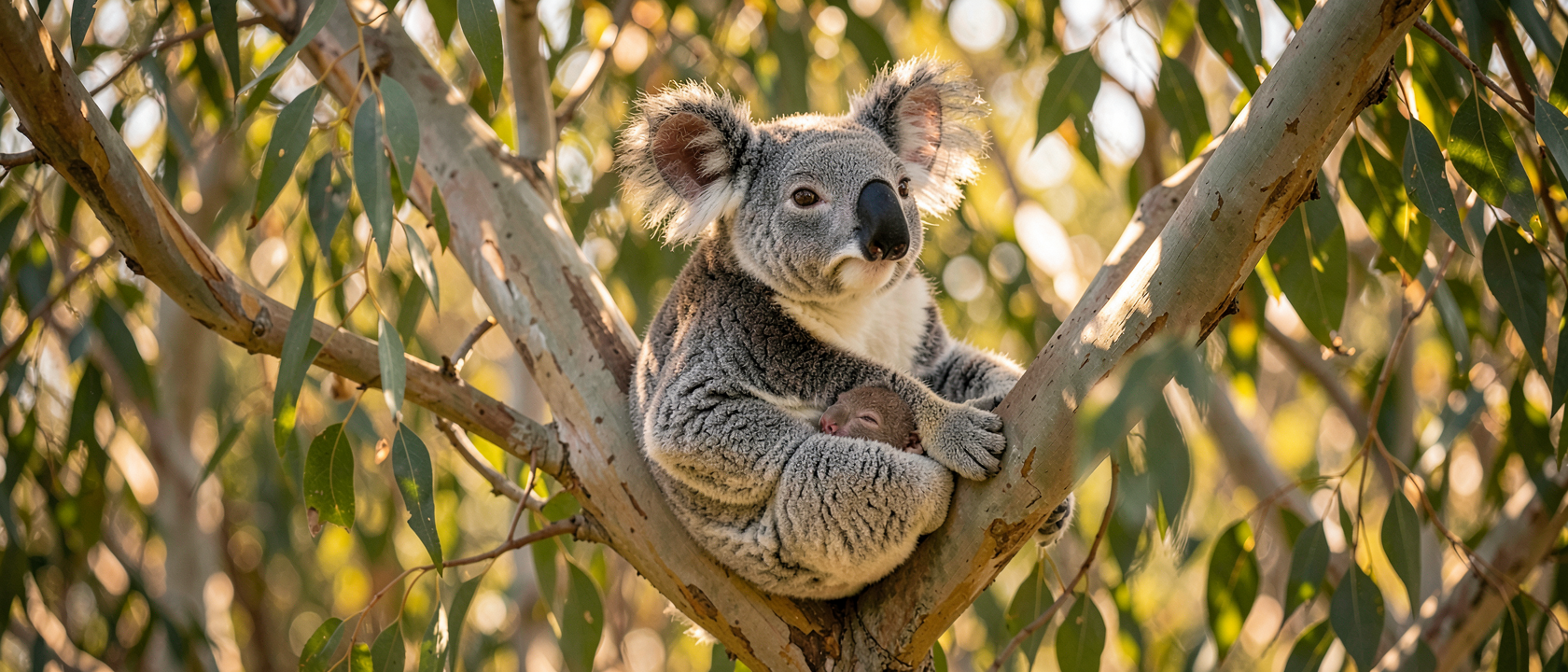
A newborn koala (Phascolarctos cinereus) is smaller than a jellybean, under 1 inch (2.5 cm) long and weighing less than 0.035 ounces (1 gram). It’s born blind and hairless, and it crawls on its own, unaided, into its mother’s pouch to keep developing. It stays there nursing for roughly seven months.
Then it hits a wall. The only food waiting outside the pouch is eucalyptus, and eucalyptus is fibrous and loaded with toxic compounds that most animals can’t touch. A joey’s gut isn’t ready for any of it. The only way through is a soft paste the mother produces, and in plain terms, that paste is a form of her waste.
Not Regular Droppings: How Pap Actually Works
“Pap is a different type of feces than their normal feces,” says Sally Bornbusch, a research associate at the Smithsonian’s National Zoo and Conservation Biology Institute. It’s made in the cecum, a fermentation pouch where the large intestine begins, and Bornbusch and Chris Massaro, senior vice president and chief zoological officer at ZooTampa at Lowry Park, describe it as mushy rather than pellet-shaped, distinct in texture from what an adult koala normally leaves behind.
Massaro describes joeys as knowing instinctively when they’re ready for it, at around 5 to 6 months old and roughly 10.6 ounces (300 grams), while still living in the pouch. The joey initiates the process itself, nuzzling the area around the mother’s cloaca, the shared opening for urine, feces and reproduction, to trigger the pap’s release. This isn’t scavenging leftovers. It’s a targeted secretion the mother’s body produces for exactly this purpose.
The Second Why: A Starter Culture, Not a Snack
Bornbusch says pap “probably” delivers the gut microbes a joey needs to digest tough plant fiber, and probably helps start neutralizing some of the harmful compounds in eucalyptus too. Note the hedge: that’s her working explanation, not a settled proof. She compares the function, loosely, to rabbits re-eating their own cecotropes for a second pass at the nutrients they missed the first time, though the underlying mechanics differ between the two animals.
Pap works less like waste and more like an inheritance: it carries the bacteria that make a life on eucalyptus possible. It’s handed over at the exact developmental point where the joey’s future diet would otherwise kill it.
The Myth This Kills: Koalas Aren’t the Weird One
The instinct is to file this under gross animal trivia: koalas eat poop, ha. A 2024 study by Bornbusch and Erin Kendrick, published in Animal Behaviour, shows that framing is wrong twice over. First, pap is explicitly not the same substance as a koala’s regular droppings, as Bornbusch’s own description makes clear. Second, eating fecal matter for nutrition at some point in life is documented in more than 150 species: ostriches, iguanas and juvenile African elephants among them, with western lowland gorillas, leopard tortoises and dung beetles doing it routinely as adults.
With over 150 species doing this at some life stage, koalas fit a common pattern, not an outlier one.
Sydney, on Camera
In 2019, Chris Massaro helped bring a koala joey named Sydney into the world at ZooTampa at Lowry Park in Florida. Sydney’s pap-feeding, the nuzzling, the pouch, the whole sequence rarely documented in the wild, was caught on camera. The footage later appeared in National Geographic’s Underdogs series, in the episode “Terrible Parents,” which premiered on National Geographic on June 15, 2025, and began streaming on Disney+ and Hulu the following day.
Sydney is one joey, filmed once. It’s not a stand-in for how every koala does this. But it’s the rare case where the mechanism in the section above stops being a description and becomes something you can actually watch.
What Nobody Has Mapped Yet
No one has published the exact biochemical makeup of pap, and nobody has pinned down precisely which toxic eucalyptus compounds it helps a joey’s gut start handling. Bornbusch’s “probably” is doing real work in that sentence: the transfer of useful gut bacteria is the working theory, not a fully mapped process.
Even the trigger on the mother’s end is unresolved. One koala keeper has described a physiological shift inside the mother that seems to switch pap production on, but that’s a practitioner’s field observation, not a confirmed mechanism. The joey’s timing, at 5 to 6 months and about 10.6 ounces, is well documented. What flips the switch in her body is still an open question.