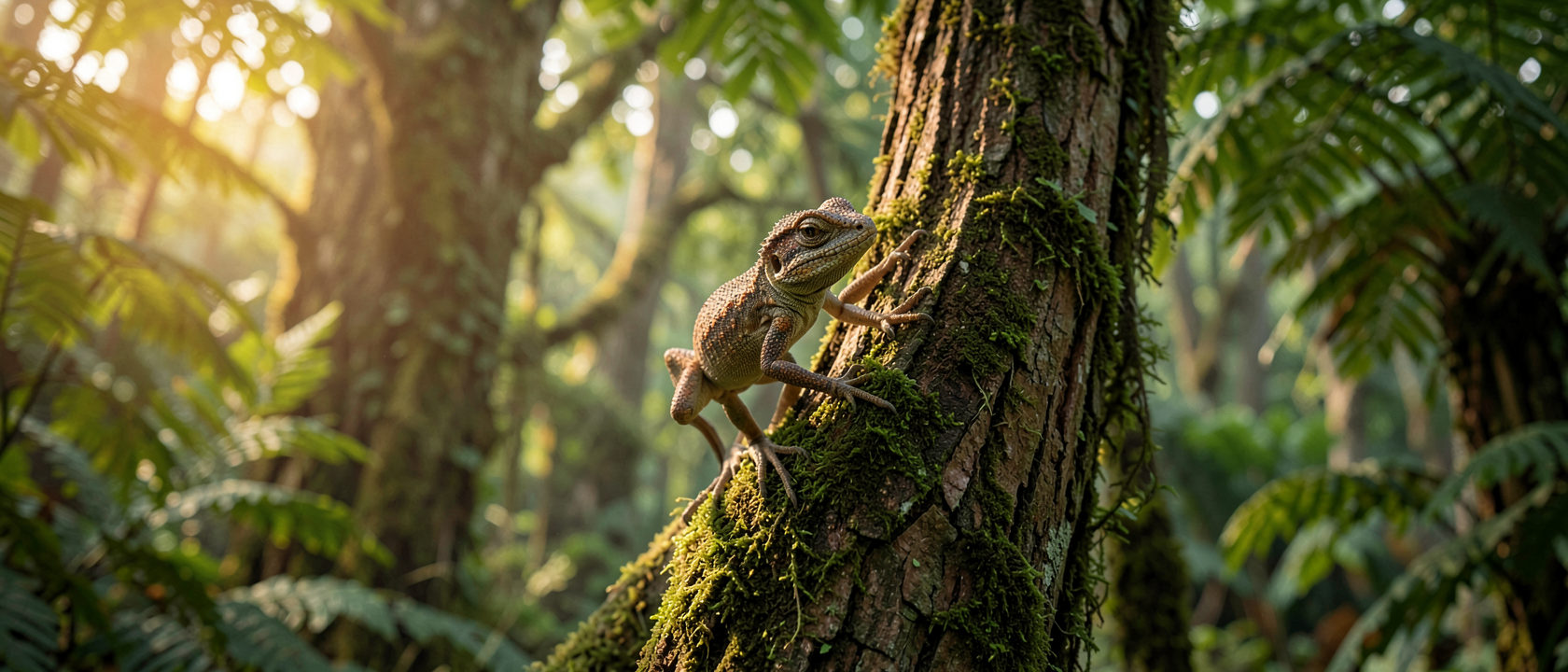
The reptile that spent a century in two museums, in two pieces, under two roofs
Sphenodraco scandentis lived in the Solnhofen Archipelago of what is now Germany more than 145 million years ago, in the Late Jurassic. It was a rhynchocephalian, a lizard-like reptile related to lizards but not one of them. For close to a century, nobody knew it existed, because the single fossil that proved it had ever lived was cut in two and sold to different buyers.
One half ended up at the Natural History Museum in London, cataloged as specimen NHMUK PV R 2741. The other, the main slab, went to the Senckenberg Natural History Museum in Frankfurt, filed under a different animal’s name entirely. The two pieces stayed apart for almost a century, until Victor Beccari, a PhD student based at the Palaeontological Museum in Munich who was researching fossil reptiles at the Natural History Museum in London, recognized that a specimen in the London collection was the missing counterpart to a fossil he had already studied in Frankfurt. That single match is the reason this species has a name only now.
How a short body and long fingers put it in the trees
Once reunited, the skeleton told a specific story. Sphenodraco scandentis had a short body of about 6 inches (15 cm), paired with unusually long limbs and long, slender finger bones, proportions that belong to neither a ground runner nor a swimmer. The describing team compared those measurements to living lizards with known lifestyles, among them Bronchocela crested lizards and Draco flying lizards, both climbers and gliders. The match was close enough to place Sphenodraco in the branches of Jurassic island forests rather than on the forest floor.
The comparison only works because rhynchocephalians span a wide range of body plans. Pleurosaurus, a relative from the same broader group, was fully marine and nothing like a climber. Sphenodraco sits at the opposite end, built for trees, showing how far that range actually stretched. None of this comes from a filmed animal in motion. It comes from reading bone proportions the way an engineer reads a blueprint, and matching them to animals alive today whose habits are already documented.
What reuniting the halves actually proved
The two pieces were not duplicates. They were what paleontologists call part and counterpart: when a fossil slab splits, one side keeps most of the actual bone, and the other keeps a mirror-image impression pressed into the opposite face. The Frankfurt piece held most of the skeleton itself; the London piece held the impression. Neither one alone showed enough detail of the tooth orientation or the hip bone structure to settle what kind of animal this was. Together, they did.
That combined detail let researchers date Sphenodraco scandentis to more than 145 million years ago and call it the oldest tree-dwelling rhynchocephalian on record. It is not only a new name added to a list; it pushes back the point at which this reptile group is known to have taken to the trees, which matters for a lineage that today has exactly one surviving species, the tuatara of New Zealand.
It had a name already, the wrong one
Before Beccari’s discovery, the Frankfurt slab already carried a label: Homoeosaurus maximiliani, an already-named species. Nobody had reason to question it, because half a skeleton, without its counterpart, did not show the features that would have said otherwise. Once both halves were studied side by side, differences in tooth orientation and in the shape of the hip bones ruled that identification out. The animal was something the record had never named at all.
The correction runs deeper than one fossil. For decades, Jurassic rhynchocephalians with longer limbs were sorted into Homoeosaurus, and ones with shorter limbs into Kallimodon, as though those two names covered all the variation in the group. The describing team argues that sorting was too coarse, and that real diversity among Jurassic rhynchocephalians has likely been folded into just those two bins for longer than anyone noticed. There are reportedly still undescribed specimens sitting in collections that may turn out to be further new species, waiting for someone to do for them what Beccari did for Sphenodraco.
The dealer who allegedly cut a fossil in half to sell it twice
The story attached to the split, as it has been passed down with the specimen, is that a fossil dealer decades ago realized a part-and-counterpart pair could be sold as two separate objects instead of one, and did exactly that, without telling either buyer the other half existed. No dealer is named, and the account is specimen history rather than a documented sale, retold more than verified, and not something the study set out to confirm.
If it happened the way the story goes, the dealer collected two payments for one fossil. He also, without meaning to, buried a new species for the better part of a century, one slab in London, one in Frankfurt, each missing the exact piece of evidence that would have explained what the other one actually was.