Something in Less Than a Millimeter of Eye
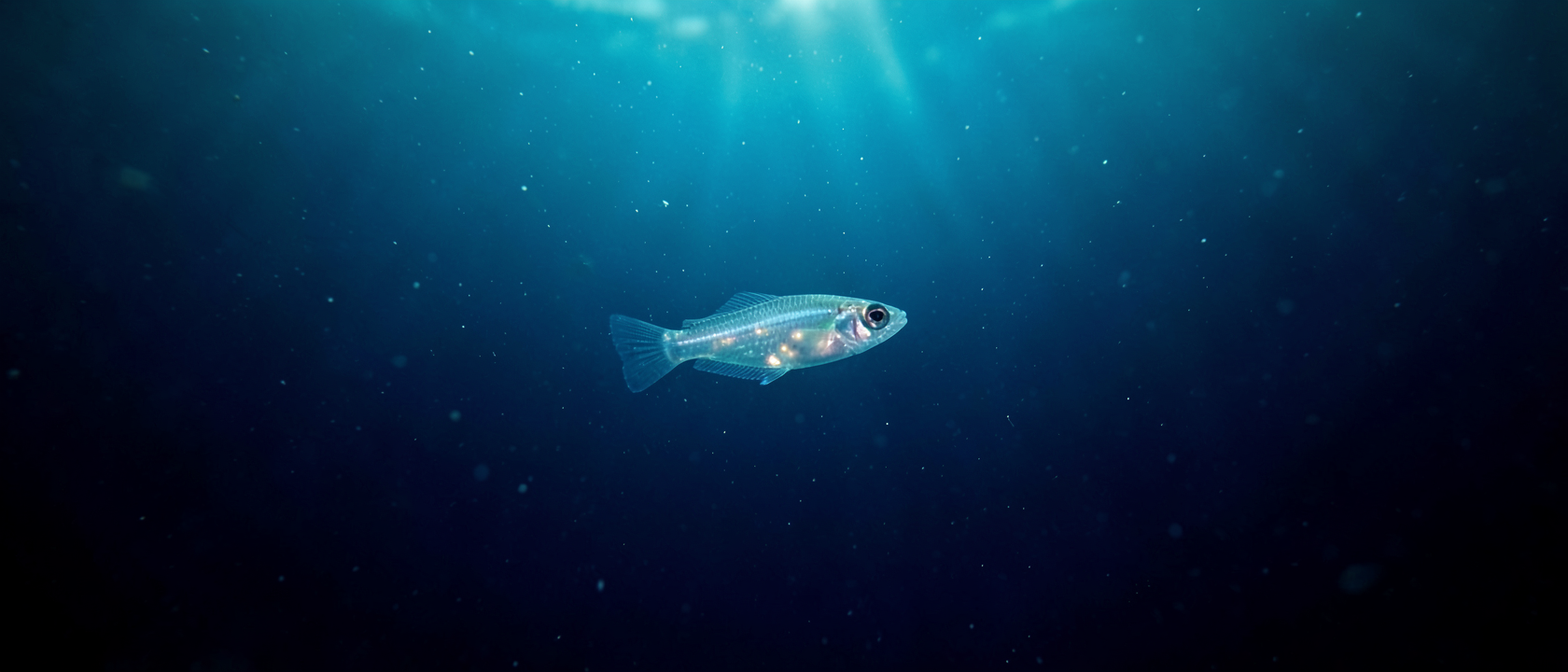
A deep-sea fish larva just 0.2 inches (half a centimeter) long, with eyes smaller than 0.04 inches (under a millimeter) across, is carrying a type of eye cell that no vertebrate has ever been shown to have. In February 2026, a team led by Dr. Fabio Cortesi, Dr. Lily Fogg, and Dr. Fanny de Busserolles at the Queensland Brain Institute, University of Queensland, working with collaborators in Switzerland, Saudi Arabia, Norway, and the United States, published the finding in Science Advances. The larvae came from three deep-sea species: the pearlside Maurolicus mucronatus, the lightfish Vinciguerria mabahiss, and the lanternfish Benthosema pterotum, all caught between 66 and 656 feet (20 and 200 meters) down in the Red Sea during a series of marine survey trips. Fogg later described the fieldwork itself as maddeningly fiddly, dissecting eyes that size from bodies half a centimeter long under a scope. The novelty here isn’t the fish. It’s a new kind of cell, sitting inside an eye you could lose in a seam of fabric.
A Cone Wearing a Rod’s Coat
Vertebrate eyes have run on two building blocks for so long it reads as settled biology: cones, tuned with one set of genes to work in bright light, and rods, built long and thin on a different genetic program to catch whatever light is left after dark. The textbook version adds a rule about timing, too: every vertebrate retina is supposed to develop cone-dominated first, then add rods later as the animal matures. The cell this team found complicates both halves of that story at once. Using light and electron microscopy, transcriptome sequencing, and spectral sensitivity modeling, the researchers showed these cells run cone genes, the molecular kit built for daylight, packed into the elongated, rod-shaped body normally reserved for night vision, and they show up in the larvae, not later in life, upending the supposed order of operations along with the supposed categories. They call it a transmuted photoreceptor, and their spectral predictions suggest the mash-up sharpens sensitivity to dim, blue-shifted light, the exact wavelength that dominates at twilight depths in open water. A cell built like this doesn’t read as a cone doing a rod’s job by accident. It reads as something built on purpose, for a light level that is neither day nor night.
An Eye Built for a Commute
These larvae live and feed near the surface, in the half-light of the upper water column. As adults, the same species move on: some descend as far as 0.6 miles (1 kilometer) down, into water with almost no light left in it at all. What the researchers found suggests the hybrid cell is less a fixed trait of the species than a stage of that journey. In Maurolicus mucronatus, the transmuted photoreceptors stay put into adulthood. In Vinciguerria mabahiss and Benthosema pterotum, they don’t: both species trade them for retinas built from ordinary rods as the fish sink and the light thins toward nothing. Three species, one shared twilight solution as larvae, and two different adult outcomes. The eye isn’t fixed at hatching. It looks built one leg of the trip at a time, with the destination deciding how the wiring finishes.
Two Cell Types, Zero Exceptions, Until Now
For more than 150 years, vertebrate vision science has run on a strict binary: cones for bright light, rods for dark, nothing in between, and a fixed developmental order layered on top, cones first, rods only once the animal is older. It was taught with total confidence because it had been checked so many times. A related 2017 study from some of the same University of Queensland researchers had already dented one corner of that model, finding that adult pearlside retinas weren’t the pure-rod structures long assumed, but a mix of rod-like and cone-like cells. The 2026 paper goes further and breaks the rule outright: not two categories a species mixes and matches, but a third kind of photoreceptor, cone genetics wrapped in a rod’s shape, discovered in a fish larva the length of a grain of rice.
What Nobody Has Checked Yet
The paper answers one obvious question and opens several more. It does say what happens to the hybrid cell in the three species studied: kept through adulthood in the pearlside, replaced by true rods in the lightfish and the lanternfish. It doesn’t say why those paths split, what turns the molecular switch that decides whether a species keeps the hybrid or trades it in, or how many other deep-sea species might be running the same twilight workaround; this study looked at three, out of an ocean full of candidates. Cortesi has raised the possibility that a cell built this precisely for low light could eventually inform low-light camera sensors, or that watching it develop under deep-ocean pressure could say something about human eye conditions like glaucoma, both floated as directions worth chasing, not results already in hand. For now, the honest state of things is a genuinely new cell type, described and only half-explained, still short an answer to the biggest question: what tells one larval eye to keep it, and another to let it go.