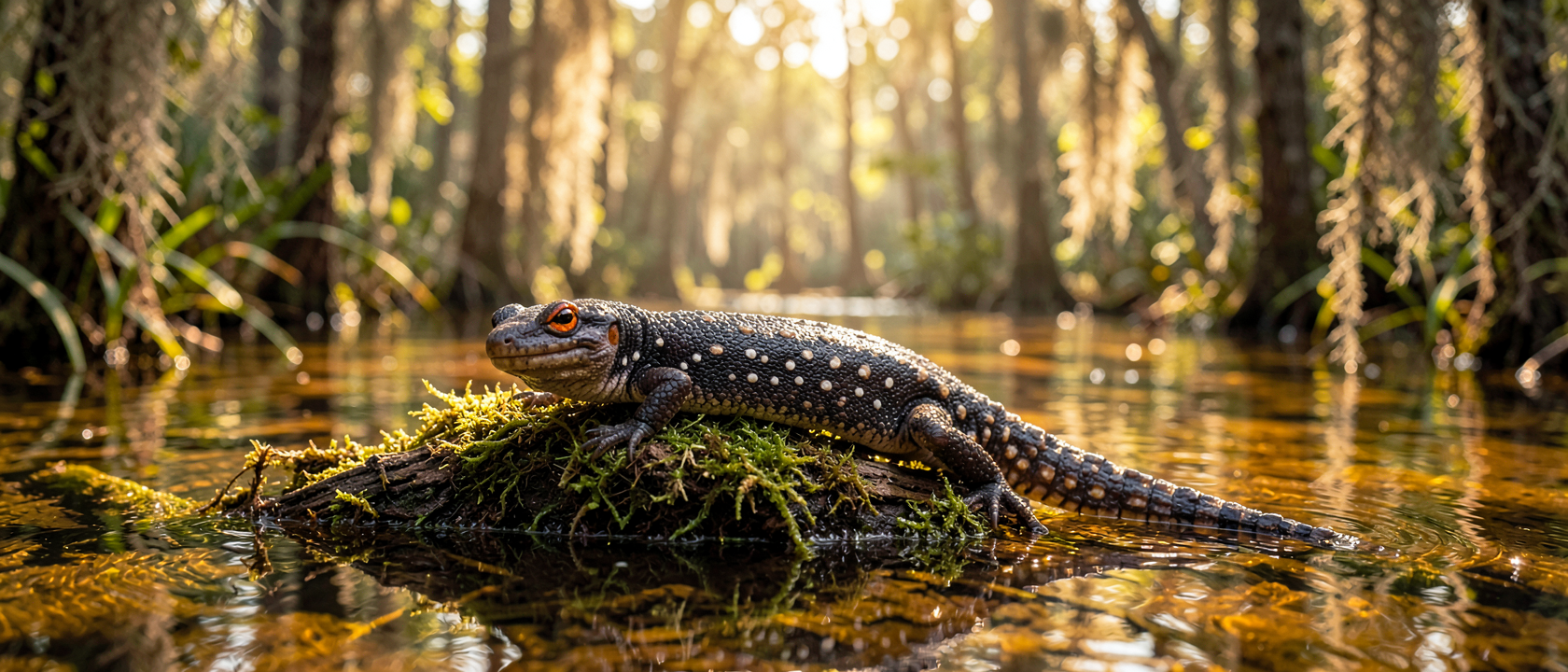
A New Species Found Without a New Frontier
In 2022, biologist R. Alexander Pyron of George Washington University and three co-authors, Kyle A. O’Connell, Jennifer Y. Lamb, and David A. Beamer, published the formal description of a new salamander in the journal Zootaxa. They named it Desmognathus pascagoula, a swamp-dwelling amphibian found only in the Gulf Coastal Plain of southeastern Mississippi and southwestern Alabama.
This isn’t a cave nobody had entered or a mountain range nobody had climbed. It’s a stretch of the American South that naturalists have walked, mapped, and cataloged for hundreds of years. This salamander was sitting in a museum drawer, in a place people already thought they knew.
How You Split a Species You Can’t Tell Apart
Desmognathus pascagoula looks almost identical to its close relative, Desmognathus valentinei, itself only recently described. No naturalist could split them on sight, not with a decade of field experience and not with a hand lens. Pyron’s team found the boundary a different way: they sequenced the genomes of both and found consistent differences across 881 genes between the two populations.
That genetic split held up under a second, independent test. The researchers compared body structure using preserved specimens from the Smithsonian’s National Museum of Natural History, measuring the two species alongside a third relative, Desmognathus conanti. D. pascagoula turned out to have a longer, more slender body and a narrower head and nostrils than both. The genome flagged the difference first, and the skeleton confirmed it. The animal you could actually point a camera at came last.
Why Dusky Salamanders Keep Doing This
Desmognathus, the dusky salamanders, are what herpetologists call a cryptic species complex: separate lineages that have genuinely split apart over time while keeping almost the same outward look, because whatever pressure shaped their evolution never touched their appearance. That is exactly why this genus keeps producing newly recognized species even after decades of close scientific attention. Field biologists were never going to catch D. pascagoula by staring harder at color pattern, because color pattern was never where the difference lived.
The split lives in genes and in skeletal proportions, in measurements a predator, a mate, or a herpetologist with a hand lens would never register. The salamander was never hiding. The tools needed to detect it simply didn’t exist until someone ran a genome through a sequencer.
The Myth This Kills
There’s a quiet assumption that a country this walked over, this mapped, this photographed for field guides, has nothing left to discover. This finding argues against that directly. Roughly 750 salamander species are known worldwide, and about a third of them already live in North America. One more was sitting undetected in the Gulf Coastal Plain the entire time, a region researchers now flag as a candidate biodiversity hotspot, not despite centuries of study but almost because of it. Decades of specimens have been sitting in museum drawers, waiting for someone to run the right test on them.
Pyron put it in personal terms when he spoke with George Washington University’s news office: discoveries like this show how much is still waiting in what he called “our own backyards,” language he tied to biologist E.O. Wilson’s description of the region as “America’s Amazon.” That’s one researcher’s framing, not a separate finding, but it lands in the same place the data does: well-studied and fully known are not the same claim.
What Nobody Knows Yet
Pyron and his co-authors are direct about the gaps. Nobody has described D. pascagoula’s diet, its breeding behavior, or its day-to-day habits. Its range is only partly known: researchers currently recognize six living populations in the lower Pascagoula, Escatawpa, and Mobile drainages, and a historical specimen suggests the species once ranged more widely before land use in the region changed, but nobody has mapped where it lived then against where it survives now.
The researchers also suspect more undescribed Desmognathus species remain in the same stretch of coastal plain. That’s a suspicion built on the pattern this discovery revealed, not a finding on its own. Anyone photographing a dusky salamander in the region is now being asked, by Pyron himself, to get the lateral surfaces of the body and head in frame, showing the portholes, the postocular stripe, the shape of the snout. The identification markers exist. Nobody has finished tracking where they show up.