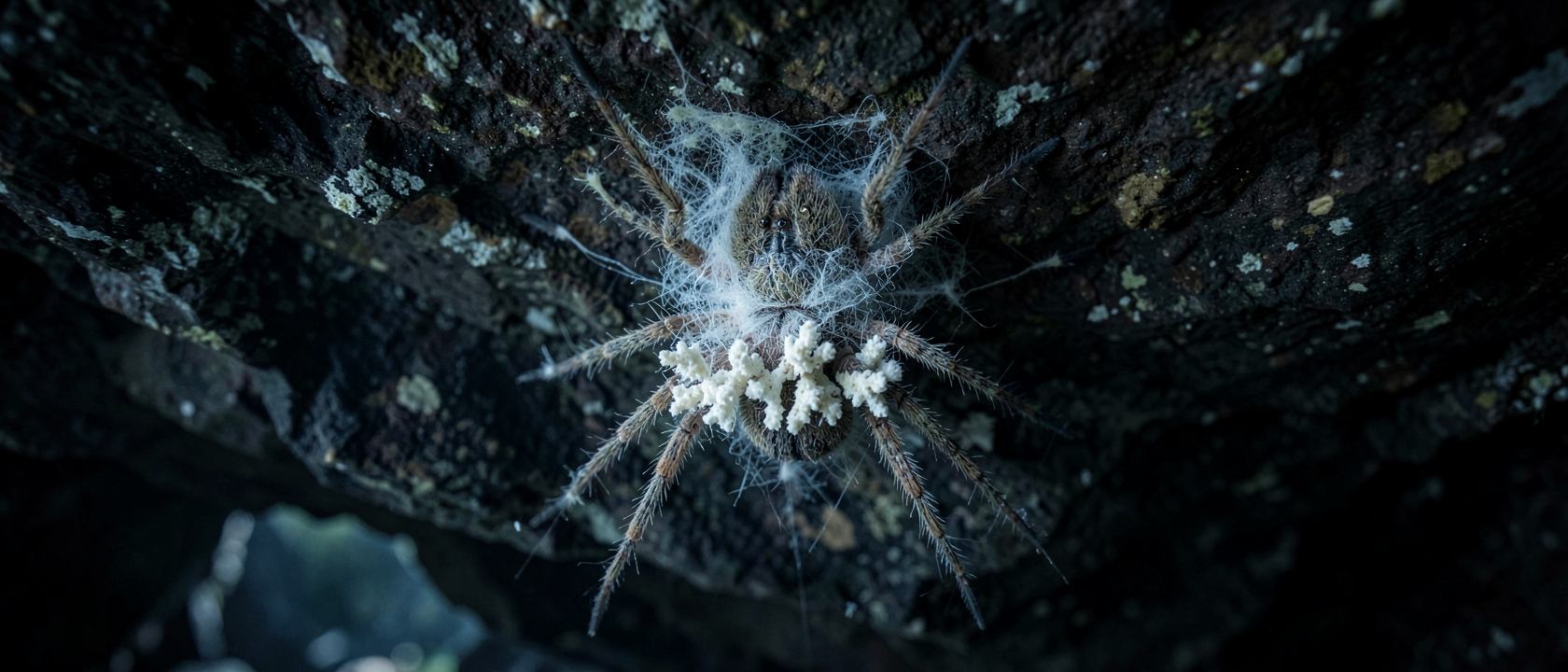
A Coral-Crowned Corpse on the Ceiling
The spider was dead, upside down on the ceiling, and dressed in something that looked like a sprig of white coral. A BBC Winterwatch crew filming inside a disused gunpowder store at Castle Espie, in County Down, Northern Ireland, found it there in 2021, spotted by WWT volunteer Jonathan Clark. Someone thought it looked less like a spider and more like a decoration, and sent photos to a mycologist.
That mycologist was Harry Evans, an emeritus fellow at CABI (the Centre for Agriculture and Bioscience International). The growth was first taken for Gibellula pulchra, a known lookalike, until Evans suspected the crew had photographed something nobody had described before. Genetic work confirmed it: a new species, later named Gibellula attenboroughii after Sir David Attenborough, whose early work at the BBC helped build the Natural History Unit that eventually sent a crew into that storeroom. Before the formal name was settled, some BBC Springwatch viewers had already nicknamed it “Gibellula bangbangus,” a nod to the gunpowder store where it turned up. Once researchers knew what the fungus looked like, a local caver helped them find more of it, this time on two spider species, Metellina merianae and Meta menardi, in cave systems across both Northern Ireland and the Republic of Ireland. The genus Gibellula itself is not new. More than 30 species are known, nearly all of them from the tropics. The British Isles, before this find, had exactly one.
A Hermit That Stopped Hiding
Metellina merianae and Meta menardi are not spiders you tend to see. Both are sit-and-wait hunters that spend their lives pressed against cave walls or tucked at the edge of a web, rarely out where light or air currents reach them. That is the whole point of a cave spider: stay hidden, stay still, let prey come to you.
Every infected specimen the researchers found broke that rule in the same way. Each one was dead in the open, on a ceiling or a wall, nowhere near the sheltered spots these species normally never leave. Evans and his co-authors, writing in the paper describing the species, call this a likely behavioral change, “possibly manipulated by the fungus.” The fungus enters the spider’s body and colonizes its hemocoel, the cavity that carries the invertebrate equivalent of blood. What happens between infection and death is not observed directly. What is observed, consistently, is where the bodies end up: exposed, elevated, positioned exactly where air moving through a cave or storeroom would carry spores the farthest. “This manipulation of the host serves to spread the fungus’s spores,” Evans said. The corpse becomes the delivery mechanism.
Same Fungus, Two Costumes
In the gunpowder store, sealed off from wind and daylight, the fungus grows tall, pale, column-like spore structures that stand up from the body like the coral the film crew mistook it for. In caves, where air moves and some light gets in, the same fungus produces something shorter and looser, spore chains that barely resemble the storeroom version. Side by side, the two growths do not look like the same organism.
Genetic sequencing settled the question anyway: same species, Gibellula attenboroughii, in both places. The visual gap tracks environment, airflow and light, not ancestry. It is one genome producing two different-looking outputs depending on the room it happens to be growing in.
The Species That Wasn’t Two
Given how different the gunpowder-store form and the cave form look on sight, it would have been reasonable to assume they were separate fungi that happened to share a taste for the same spiders. That assumption does not survive the genetics. Sequencing collapsed both growth forms into a single species, described in the same 2025 paper, published online January 24, 2025, in Fungal Systematics and Evolution. One fungus, two disguises, and the disguise is set by the room, not the DNA.
What Nobody Has Confirmed Yet
Fungus-covered Metellina merianae have also turned up at a lakeside site in Wales that has no caves at all. There, the spiders normally live in rock fissures and man-made crevices rather than cave systems, and researchers suspect the same fungus is at work, possibly pushing spiders out onto overhanging moss instead of cave ceilings. Whether it is actually Gibellula attenboroughii, or something else that produces a similar effect, has not been established.
The larger gap is the mechanism itself. Nobody has watched an infected spider mid-manipulation, moving from its retreat toward open ground. Every conclusion about behavioral change comes from where the corpses were later found, not from footage of the process. The researchers also note that old herbarium records hint at other undescribed Gibellula species already sitting, unrecognized, in British collections.
What the Corpse Tells You About Yourself
None of this works as a mystery unless you already know these spiders are supposed to be hiding. A stranger walking past that gunpowder store would have seen a dead spider with a strange growth on it and moved on. Recognizing that the position itself is wrong, that a Metellina merianae has no business dying in plain sight, is what turns a coral-crusted corpse into a question worth answering. That is the difference between finding something unsettling and finding something explicable, and it is the whole reason this story is worth forwarding rather than just wincing at.