The Blink That Won an Award
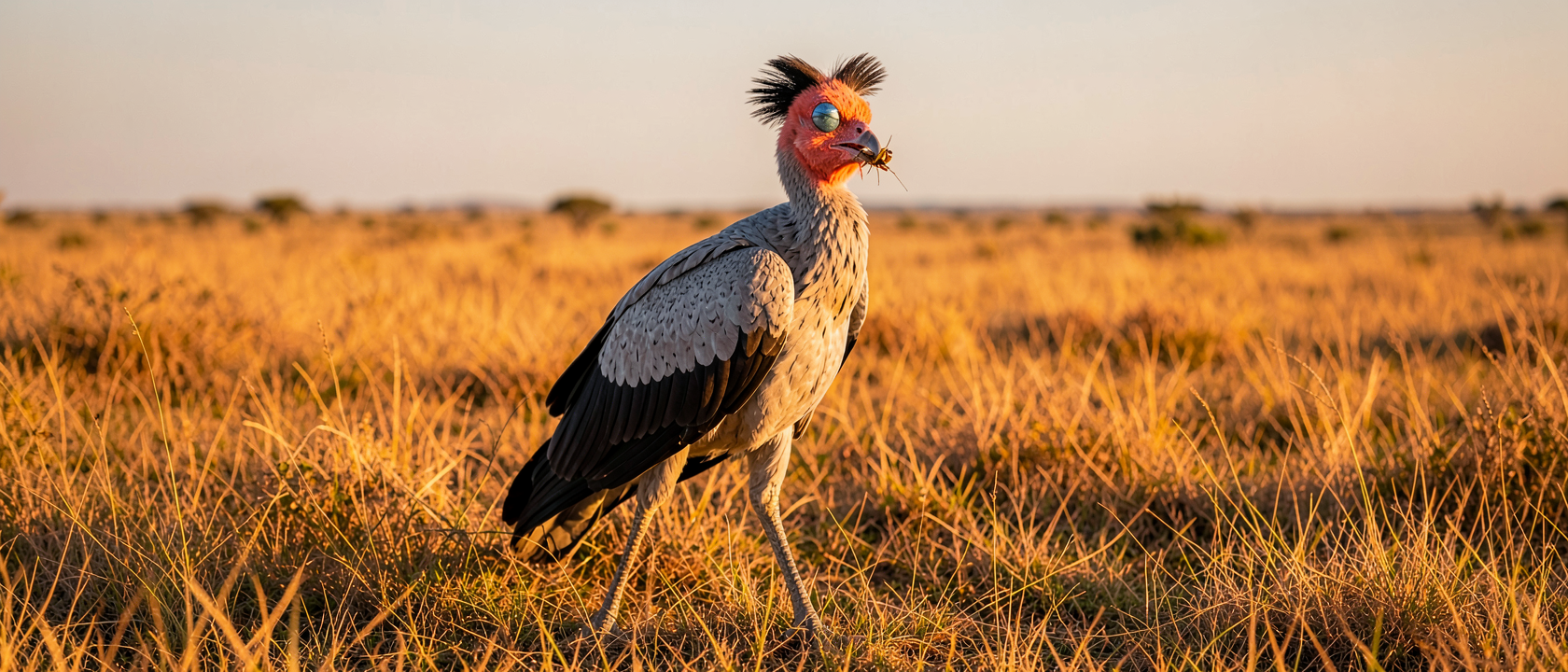
A secretary bird catches a locust, and as it swallows, its eye turns into a smooth blue ball. Not a blink. Not a squint. A translucent membrane balloons up over the eyeball like a marble dropped into the socket, too fast to see without a high-speed shutter. Biologist and photographer Peter Hudson caught it happening.
The image, titled “Secretary Bird Gullet,” won the ecology and environmental science category of the 2024 Royal Society Publishing Photography Competition, run jointly with the Royal Photographic Society to highlight hidden scientific phenomena in the natural world. Hudson shot it at 1/2000 of a second, ISO 100, f4.5, fast enough to freeze a movement most eyes, and most cameras, never catch.
The bird’s throat is mid-swallow. Its eye is not an eye anymore. It is a pale blue sphere, caught for one frame and nothing more.
Nature’s Goggles: How the Third Eyelid Works
What Hudson photographed is a nictitating membrane, a third eyelid most people never think about because it lives beneath the two everyone knows are there. According to the National Audubon Society, it sits underneath the upper and lower lids, hinged at the inner corner of the eye, and sweeps sideways across the eyeball rather than dropping down like an ordinary blink.
Its job, per Audubon, is mechanical: keep the eye clear of dust, wind and anything solid enough to scratch it, which is how it earned the nickname “nature’s goggles.” This piece of hardware is not unique to the secretary bird (Sagittarius serpentarius). Plenty of birds carry one. What makes this photograph unusual is how visible, and how vividly blue, this particular bird’s version turned out to be, caught head-on at the exact instant it ballooned into that ball shape. Nothing here is a new behavior. It is standard bird anatomy, doing the job it always does, photographed at the one moment it is impossible to miss.
Why Blink at the Swallow, Not the Strike
Here is where it gets interesting. Hudson’s own reading of his photograph is specific: the membrane does not close when the bird strikes its prey. It closes when the bird swallows it. “This bird has just caught a locust, and as it swallows its prey, it synchronously closes its third eyelid, the nictitating membrane, across its eyes to protect them from damage,” Hudson said.
To see why that timing might matter, look at how a secretary bird actually hunts. Grey-feathered, bare-faced in red-orange skin, it is built like a cross between a falcon, its real evolutionary relative, and a stork, its adopted way of life. Rather than hunting from the air like a typical raptor, it walks the savanna on legs that can carry its body to as much as 4.3 feet (1.3 m) tall, and it kills by stamping, pinning locusts, lizards and amphibians to the ground with its feet before eating them. The strike is a stomp, over fast. The swallow is the part where a still-moving animal goes down close to the bird’s face and eyes. If Hudson’s reading is right, that stretch, not the stomp, is when the eye is most at risk, and that is exactly when the goggles come down.
What Nobody’s Actually Measured
What the photograph does not settle is why the timing lands on the swallow rather than the strike, or on both. Hudson’s account describes what he saw and what he believes it is for. It does not come from a study that tracked the membrane frame by frame, in this bird or any other. There is no frame rate given beyond the single 1/2000-second exposure, no count of how often this happens across a meal, and no comparison to how other raptors’ third eyelids handle the same moment of contact. One photograph is one instant. It is not a dataset, and nothing about it claims to be.
The Sharks That Stole the Show
Even a bird with its own built-in safety goggles did not take the top prize. The overall winner of the 2024 Royal Society Publishing Photography Competition went to Dr. Angela Albi, a postdoctoral researcher at the Max Planck Institute of Animal Behavior, for a bird’s-eye shot of four sharks working together through a school of fish in the shallow waters of the Maldives. Albi took the photograph during a 2024 research trip, describing how the light at dawn and dusk turns those waters glassy and clear, which is when she and her team could best watch one shark break from calm schooling into a sudden, coordinated hunt.
It is a single photograph of a single hunt, not a claim about how these sharks behave in general, any more than Hudson’s image is a claim about how often secretary birds blink at exactly the right moment. Still, it is a fair reminder that in wildlife photography, as on the savanna, the best-timed shot does not always go to the animal with the fanciest built-in equipment.