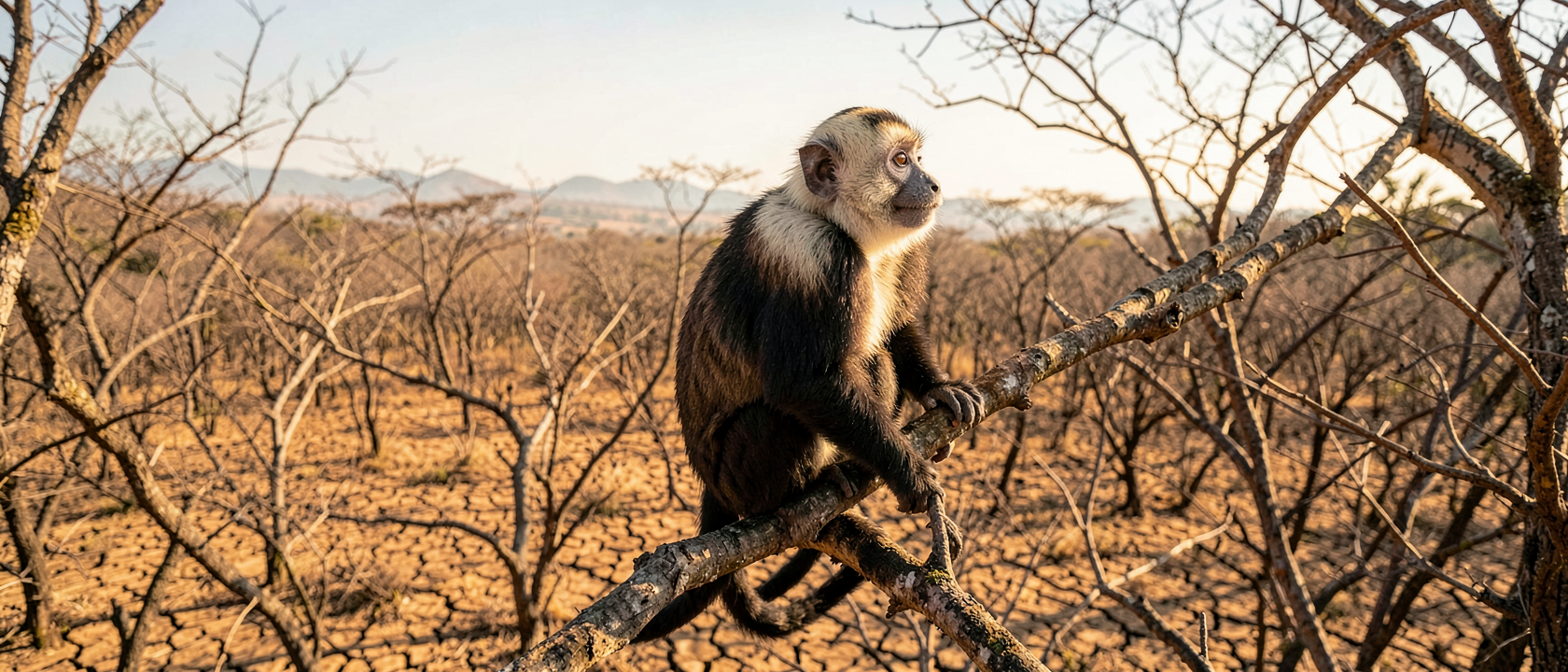
The Monkeys Whose Reaction Saved Them
Some capuchins reacted harder, and it saved them
Between 2008 and 2013, a wild population of white-faced capuchin monkeys (Cebus capucinus) at the Lomas Barbudal Biological Reserve in Costa Rica went through six years of the ordinary kind of drought: dry seasons that made food scarcer but killed almost nobody. UCLA evolutionary anthropologist Susan Perry, working with Jacinta Beehner and Sofia Carrera, along with co-authors Irene Godoy, Colleen Gault, Ashley Mensing, and Juliane Damm, had been quietly collecting fecal samples from these animals the whole time, tracking a stress hormone called glucocorticoid in each one. The team published its findings in Science Advances in 2025.
Then, from May 2014 to May 2016, an El Niño-driven drought hit Central America with a severity the region had not seen in decades. Adult female capuchins at Lomas died at 3.3 times the rate they did in ordinary years (z = 4.19, P < 0.001). Afterward, the researchers went back through six years of stored hormone data and pulled out two groups: 14 females who had lived through the catastrophe and 14 who had not. Then they asked a simple question: did their bodies look different before any of this happened?
Why a hormone spike can be a warning system, not a wound
Glucocorticoids are steroid hormones that redirect a body’s resources during a threat, shifting metabolism, dialing inflammation up or down, and adjusting immune activity to cope with whatever is happening. Every capuchin produces them under stress. The question was whether the size of that reaction meant anything for what came later.
It did. Females who mounted the steepest glucocorticoid rise during the mild droughts of 2008 through 2013 were significantly more likely to survive the extreme 2014–2016 drought, the study found. The pattern held even after the researchers controlled for pregnancy and for the time of day each sample was collected, two factors known to push hormone readings around on their own. Strip those out and the signal stayed: a bigger stress reaction to a small crisis lined up with a body that could scale up further when a much bigger crisis arrived.
The one time flexibility wasn’t enough
Perry has been watching this population for 35 years, long enough to know what white-faced capuchins usually do when conditions turn bad: switch foods, range further, rearrange the day around whatever is scarce. The 2014–2016 drought is the only time in that record the behavioral toolkit stopped working.
Monkeys lost enough weight that ribs and vertebrae showed under the skin. Mothers stopped nursing infants to spend more time foraging. Group members who normally take babysitting shifts, freeing mothers up to eat, stopped taking them. Mortality rose sharply, hitting infants and older females hardest. Because the collapse hit the whole group and not just a few unlucky individuals, the researchers argue that whatever separated survivors from casualties was not a smarter set of choices. It was something running underneath the behavior, in the body, long before the drought started.
Stress hormones are supposed to be the bad guy
The standard framework in stress physiology, in animal research and human research alike, treats a strong glucocorticoid response as a red flag: wear and tear on the body, a marker of worse health down the line. The study’s own authors note that far more work has gone into documenting the costs of chronic stress than the possible benefits of a sharp, acute one.
This study points the other way. Among these capuchins, the females with the steeper hormonal reaction to routine, low-stakes droughts were the ones more likely to make it through a genuine catastrophe. The authors describe it as the first evidence in a primate that a more robust stress response predicts better survival rather than worse. The reaction that looks like damage on a chart may be the readiness that keeps an animal alive.
What nobody knows yet
The study doesn’t explain why some capuchins mount a bigger glucocorticoid response than others in the first place. Genetics, early-life experience, and social rank are all reasonable candidates; none has been tested against this data. It also doesn’t identify the exact biological pathway between a bigger hormone spike and staying alive, whether that means faster metabolic mobilization, some form of immune priming, or a mechanism nobody has proposed yet.
And the pattern, so far, describes adult female capuchins at one site in Costa Rica. Whether it holds in males, in other capuchin populations, or in other primates entirely remains an open question, one the researchers say they want to chase next.