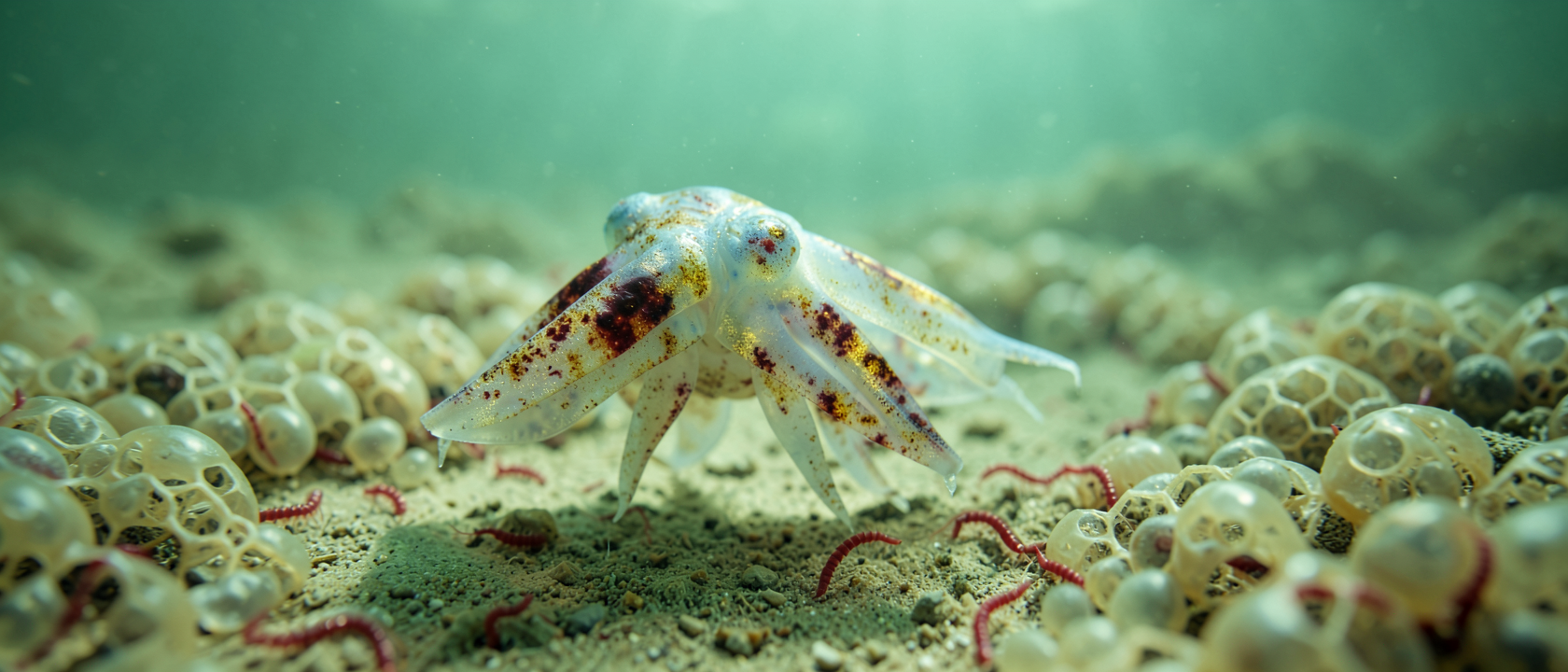
The Orgy That Kills Them
Off the California coast, thousands of California market squid (Doryteuthis opalescens, also called the opalescent inshore squid) crowd onto shallow sandy seafloor once a year, at a time and place nobody can predict, and mate themselves to death. Males flash red down their arms to signal readiness and pair with multiple partners in bouts so physically demanding that both sexes are dead within days of finishing. These squid live only 6 to 9 months total, each with a mantle (the muscular body behind the head) averaging 5.6 inches (141.3 mm) in adults, and they spend the last of that short life on a seafloor that fills up with bodies. A single female lays dozens of white, tube-shaped egg capsules, and each one holds up to 300 embryos, barely 0.08 to 0.1 inches (2.0 to 2.5 mm) long, packed side by side in jelly. Multiply that across one aggregation and the seafloor ends up carrying thousands of corpses under tens of thousands of capsules.
Enter the Worm With a Chisel for a Face
Within days, small red worms rise out of the sand and head straight for the abandoned capsules. They are Capitella ovincola, a polychaete (a bristled marine worm) that physically reshapes its own head for the job: sharpening it, then flattening it, to jab a hole through the tough capsule wall. Early observers who found the worms living inside squid egg cases assumed they must be predators eating the eggs. They are not. Capitella ovincola ignores every embryo and eats the chorion instead, the honeycomb-shaped jelly wall that keeps the hundreds of embryos separated from each other and from open water. Once a worm has punched a few holes, seawater floods in. The whole capsule swells, the gel sheet stretches thin, and oxygen levels inside climb. A capsule with no worms stays stiff and rubbery for weeks; a wormed one goes soft.
The Worm Might Be a Midwife
That softness matters at the exact moment a paralarva (the free-swimming hatchling stage) has to break out. Lou Zeidberg, a lecturer at California State University Monterey Bay, frames the relationship as a working symbiosis. The worms get a meal and a sheltered nursery out of eggs nobody is defending anymore. The squid, long dead and unable to benefit personally, get help getting millions of hatchlings out of capsules that would otherwise hold them in too long. Zeidberg puts the payoff at roughly 17 million extra hatchlings per spawning run. A 2011 study led by Zeidberg reared capsules in seawater at 56 °F (13.4 °C) and found that capsules hosting the worms hatched at a slightly higher rate than capsules without them. None of this is new. Olga Hartman, an American invertebrate zoologist, first documented worms living inside squid egg capsules in 1944, which means this relationship sat in the scientific literature, unremarked on as anything but odd, for more than eight decades before anyone called it a favor.
Or the Worm Is Just Eating the Cradle
The “always helpful” version does not survive a 2002 study by Morris and colleagues, which found the opposite effect: worm activity thinning the gel layer too far triggered premature hatching. Those larvae emerged with their yolk sacs still showing outside the body, swam poorly, and died soon after. Zeidberg’s own reading is that both outcomes are probably real, just at different worm densities: a light infestation loosens the capsule enough to help, a heavy one tears it open too soon to survive. Nobody has published the density where one tips into the other. Greg Rouse, a marine biology professor at Scripps Institution of Oceanography, adds a separate complication. Capitella worms are a textbook indicator species for pollution, multiplying explosively in nutrient-rich, oxygen-poor water; their red color comes from hemoglobin, which lets them tolerate the low oxygen that comes with a degraded seafloor. A capsule crawling with worms could be a sign of a working nursery, or a sign that the water around it is in trouble. Nothing in the record says which.
The Seafloor That Moved
Underwater photojournalist Jules Jacobs witnessed one of these spawning events at night off La Jolla Shores, California, on the sandy shelf and canyon slope where the squid gather at depths around 98 feet (30 m). Jacobs described the seabed, a thing that should have stayed fixed underfoot, shifting as thousands of squid packed together into what felt like a single moving current of bodies. It is one photographer’s account of one night, not a measurement of anything. But it is the closest thing to a picture of what tens of thousands of capsules and their soon-to-be-dead parents actually look like, before a single red worm shows up to start reshaping its head.