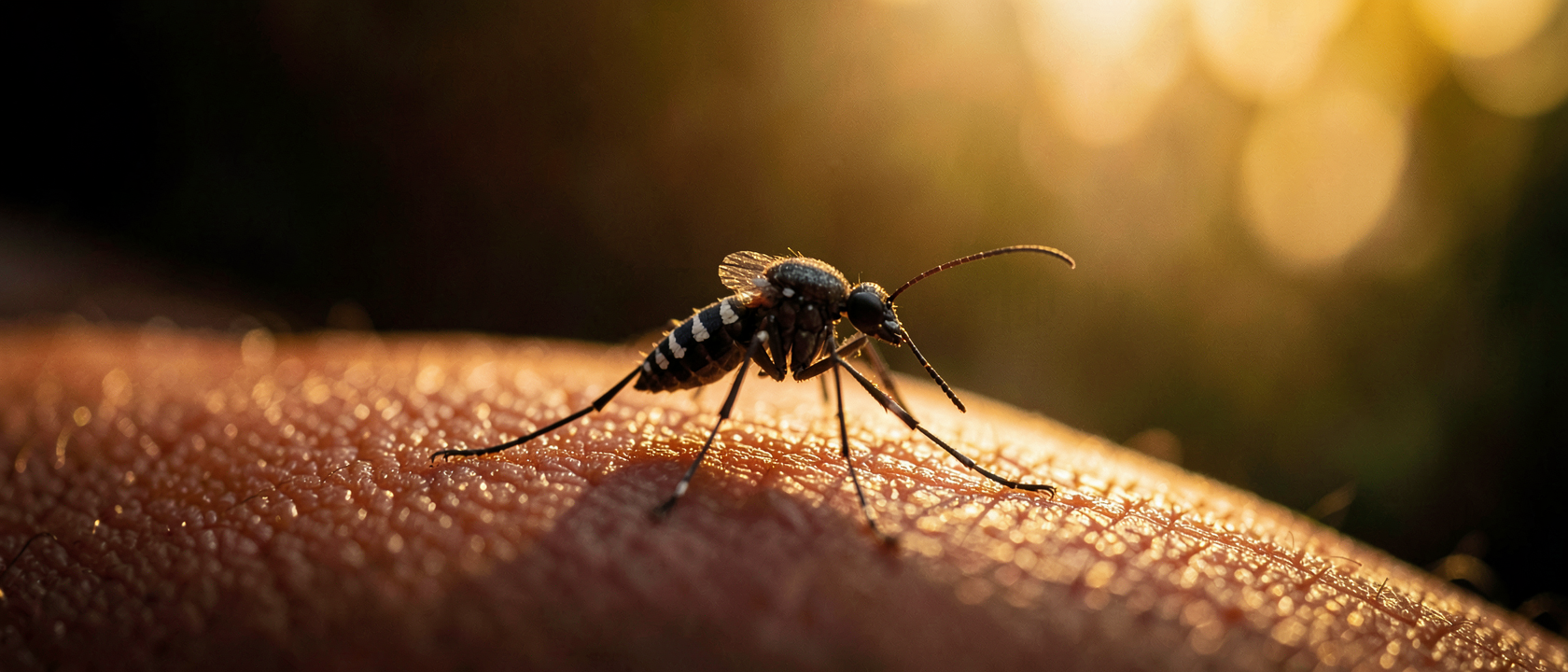
The Bite You Didn’t See Coming
Half the trained mosquitoes in this study flew straight past a bare hand and landed on one coated in DEET, the chemical that’s supposed to send them the other way. In a study published in the Journal of Experimental Biology on May 15, 2026, Claudio R. Lazzari and four colleagues, working across the University of Tours in France and Virginia Tech in the United States, conditioned Aedes aegypti, the yellow fever mosquito, a small dark insect roughly 0.16 to 0.28 inches (4 to 7 millimeters) long, marked by a lyre-shaped pattern of white scales on its thorax, and not to be confused with Culex or Anopheles mosquitoes, or its close relative Aedes albopictus, the Asian tiger mosquito, to associate DEET with feeding. When the trained insects were later offered a choice between a bare hand and one coated in DEET at normal concentrations, about 50% of them went for the treated hand. Every untrained mosquito in the same test, 100% of them, avoided the DEET hand and fed on the clean one. Same species, same chemical, opposite reading of it.
How You Train a Mosquito
Before that two-hand test, the researchers needed a way to measure what a mosquito wants, so they built one. Individual mosquitoes sat in small cages while a warm bag of blood, an artificial stand-in for a host, was moved toward them, and cameras tracked whether the insect extended its proboscis, the needle-like feeding tube, to try to feed. Lazzari’s team calls this the biting attempt response.
The conditioning turned on timing. In one training sequence, mosquitoes were left to feed on blood for 20 seconds before researchers released a puff of DEET into the enclosure, a pairing repeated three more times. When these mosquitoes later met the smell of DEET with no blood present at all, more than 60% of them tried to feed anyway. Mosquitoes that instead got the DEET puff before blood was ever on offer showed no biting attempts at all. The order in which a mosquito meets a smell and a reward decides what that smell comes to mean, the same principle behind Pavlov’s dogs, now demonstrated in an insect.
What DEET Actually Does to a Mosquito’s Nose
Mosquitoes find hosts by reading a chemical trail: exhaled carbon dioxide, lactic acid in sweat, and other skin compounds, picked up by sensory organs on the antennae, the proboscis, and the maxillary palps, a pair of sensory appendages near the mouthparts. A 2008 study cited by Lazzari’s team found that DEET does not announce danger to a mosquito’s nose. Instead, it blocks the sensory neurons that would otherwise register those host odors, in both mosquitoes and vinegar flies. DEET doesn’t warn. It jams the signal.
That distinction matters more than it sounds like it should. A hard-wired aversion, an alarm wired straight to a fixed response, isn’t something learning easily rewrites. A jammed, confusing signal is different. It’s exactly the kind of ambiguous input a nervous system can learn to reinterpret, provided the reward on the other side is big enough, and a blood meal is about as big a reward as a mosquito gets. Earlier work had already shown that a small, heritable subset of mosquitoes carries physiological insensitivity to DEET, and that others go briefly numb to it if re-exposed within roughly three hours. This study adds a layer on top of chemistry and inheritance: memory.
The Repellent That Isn’t
DEET, chemically N,N-diethyl-meta-toluamide, has been the default mosquito repellent for more than 80 years: cheap, effective for roughly five hours per application, treated as close to a settled technology. The working assumption, as the study’s authors describe it, is that insects respond to repellents in a fixed, aversive way, always, chemistry as a locked door. That assumption is what this experiment breaks. Mosquitoes conditioned to pair DEET with a blood meal reversed the valence of the smell, the pull or push it carries, from something to avoid into something to chase. Study coauthor Clément Vinauger, of Virginia Tech, spelled out the practical version of it: if someone applies DEET and the concentration on their skin fades while a mosquito still manages to bite, that mosquito may start associating the smell with a reward rather than a threat. A gold-standard repellent is only gold standard until an insect gets away with breaking the rule once.
What Nobody’s Tested Yet
None of this has been shown to happen outside a cage. The mosquitoes in this study went through a scripted, repeated training sequence at a controlled dose; wild mosquitoes meet DEET at fading, uneven concentrations, in mixed populations, with nobody timing the exposure. Whether the low, sub-repellent concentrations left on skin by ordinary sprays and lotions could condition wild Aedes aegypti populations the same way is, for now, unconfirmed. It’s also still unclear exactly what changes at the neural level when this association forms, which the researchers list as a direction for future work.
The Hand in the Cage
The clearest image from the study isn’t a data table. It’s one researcher on Lazzari’s team holding both hands over a cage of mosquitoes she had helped train, one bare, one coated in DEET. Roughly half of the trained mosquitoes flew past the clean hand and landed on the treated one, proboscis out. Every untrained mosquito in the same cage steered clear of the DEET hand and chose the bare one, doing exactly what the label on the bottle promises. The chemical worked as advertised, but only on the insects that had never been taught to ignore it.