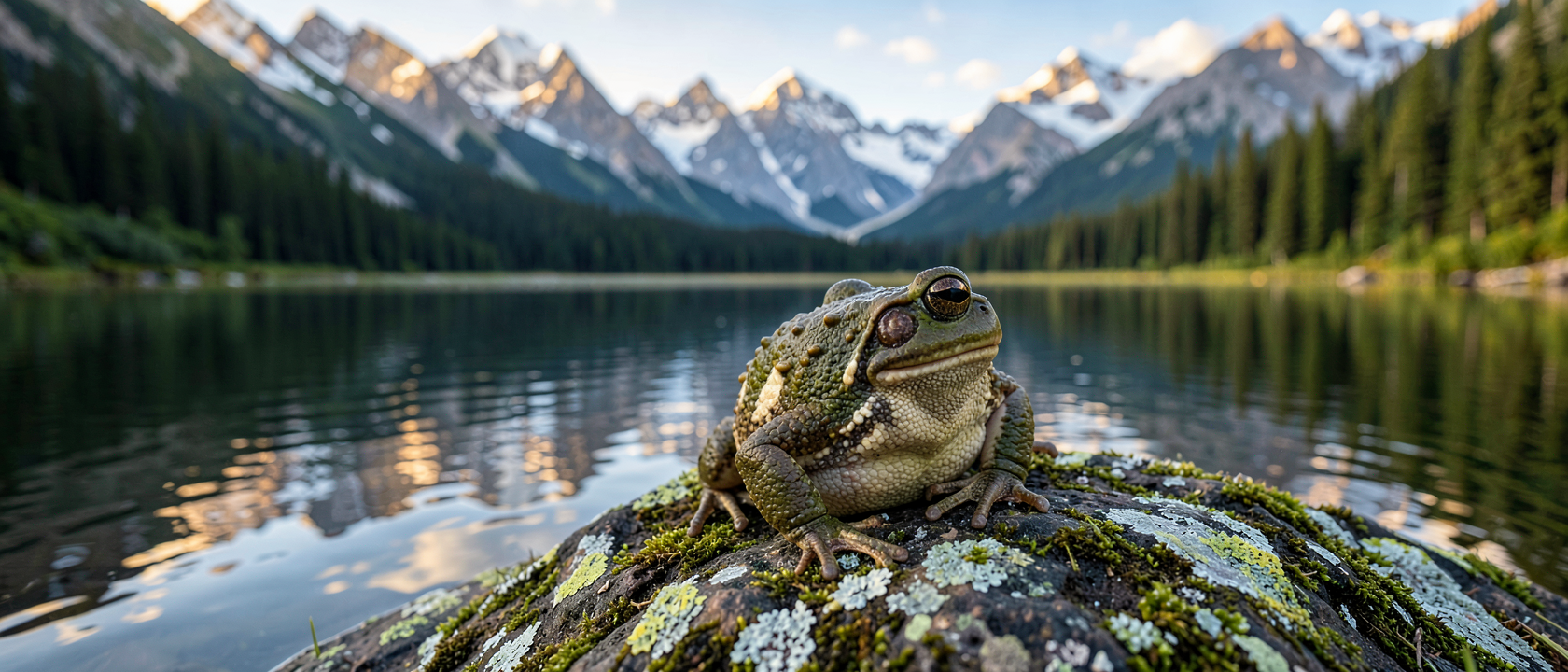
The Most Canadian Animal Isn’t the One on the Coin
A squat, warty amphibian that most people would walk past without a second look turns out to be more genetically exclusive to Canada than the beaver or the moose have ever been. PhD student Jayna Bergman, working in Professor Julie Lee-Yaw’s lab at the University of Ottawa, sequenced DNA from Western toads (Anaxyrus boreas) and their tadpoles, collected from ponds, wetlands, and lakes across Alberta and British Columbia. The results, published in Diversity and Distributions on May 29, 2026, identified a lineage of Western toad found nowhere else on the planet: not a regional variant of a common species, but a genetically distinct group confined to Canadian ground.
One Toad, Two Ways to Get a Date
Western toads east of the Canadian Rocky Mountains have a vocal sac, a stretch of loose throat skin they inflate to produce an advertisement call during breeding season. Western toads west of the Rockies, ranging on through to California and Alaska, have no vocal sac and make no call at all. Herpetologists have known about this “Calling” versus “Non-Calling” split for a while and treated it mostly as a behavioral quirk.
Bergman’s DNA analysis shows it is not a quirk. The Calling and Non-Calling toads are genetically distinct groups, and the split lines up almost exactly with the mountains themselves. The likely mechanism: the Canadian Rockies, and the sharp climate differences on either side of them, worked as a long-term barrier. One ancestral population got divided into two, and each side kept or lost the calling trait on its own evolutionary track, with small DNA differences accumulating along the way that let researchers trace who is related to whom. The split was already important enough that the Committee on the Status of Endangered Wildlife in Canada recognizes Calling and Non-Calling toads as separate conservation units. The new genetic data back up a designation that, until now, rested mostly on behavior.
Silence as a Species Boundary
A behavioral difference this stark, one population calling for mates and the other staying completely silent, paired with genetic divergence this deep, is an unusually extreme split to find inside a single recognized species. Most variation within a species is subtler: a slightly different song, a slightly different shade. This is a total loss of a courtship behavior on one side of a mountain range and full retention on the other, tracking a real genetic boundary.
That combination is exactly the pattern researchers watch for when a species might be in the early stages of splitting into two. The study’s authors frame it that way themselves, as an interpretation rather than a verdict. The Western toad, on paper, is still one species. What the DNA and the silence together suggest is that it may not stay that way.
Neither the Beaver Nor the Moose Ever Had This
Canada put a beaver and a moose on its wildlife imagery long before anyone asked whether either animal was genetically Canadian. Neither is. Both species range continuously across North America, with populations in the United States that are not meaningfully different from the ones north of the border. There is no beaver lineage, no moose lineage, that exists only on Canadian soil.
The Western toad’s Alberta population does. And Bergman’s team found a second exclusive lineage to go with it: a previously unrecognized third genetic group living in southeastern British Columbia and southern Alberta, one that likely extends south into Montana but had never been described before this study. Two unglamorous, warty amphibian populations turn out to be genuinely one-of-a-kind on Canadian ground, while the animals on the coat of arms were never exclusive to begin with. Emblem status, it turns out, was never a DNA claim.
What Nobody Knows Yet
What researchers don’t yet know is whether the Calling toads, the Non-Calling toads, and the newly identified southern group can still successfully interbreed where their ranges meet, or whether they have drifted far enough apart to be on separate evolutionary paths. Answering that requires comparing Western toads across their entire range in North America, not just the Alberta and British Columbia samples this study covered. Bergman has named that range-wide comparison as the next phase of the research.
Until that work is done, the Western toad sits in an odd position: officially one species, already listed as Special Concern in Canada and protected under the Species at Risk Act, and quietly carrying three genetically distinct populations that may or may not still recognize each other as the same animal. Next time someone points at the beaver on the nickel as the most Canadian thing in the country, you’ll know the actual answer is sitting in a ditch, not making a sound.